

Self-driving laboratories promise to transform experimental efficiency by combining robotics with AI-driven decision-making, but the case for autonomous experimentation depends on data quality, infrastructure and the nature of the scientific problem.
Laboratory automation has become an important part of modern drug discovery, helping researchers increase experimental throughput and reduce the time spent on repetitive tasks. Robotic liquid handling, automated screening platforms and integrated analytical instruments can now perform workflows that once required substantial manual intervention.
However, a further development is changing what laboratory automation can achieve. Self-driving laboratories (SDLs) combine robotics and automated experimentation with artificial intelligence (AI) and machine learning (ML), allowing systems to analyse experimental results and determine what to investigate next.
Rather than simply following a predefined protocol, these platforms can use data from one experiment to inform the design of subsequent experiments. This creates a feedback loop in which experimental planning, execution and analysis become increasingly integrated.¹˒²
Both approaches have potential applications across drug discovery, from compound screening and assay development to protein engineering and biological optimisation. However, they differ in the level of decision-making delegated to the laboratory, the infrastructure required and the problems they are best equipped to address.
For discovery teams, the question is therefore not whether self-driving laboratories are more advanced than automated systems, but whether the additional autonomy delivers enough scientific value to justify the investment.
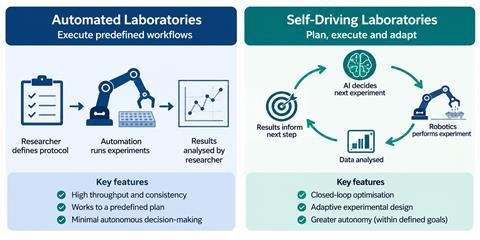
Two approaches to laboratory automation
Conventional automated laboratories use robotics, software and integrated instruments to perform predefined experimental workflows. Researchers determine the experimental design, select the conditions and then establish the parameters before the system carries out the work.
Automation can improve consistency and throughput, but the system generally does not independently decide what experiment should happen next. Changes to a protocol or the introduction of new experimental conditions usually require researcher input.
Self-driving laboratories introduce an additional decision-making layer. They combine automated experimental equipment with computational methods that can analyse results, select subsequent experiments and adjust experimental parameters in pursuit of a defined objective.¹˒²
A typical SDL operates through a closed-loop workflow: an algorithm proposes an experiment, the robotic system performs it, the resulting data are analysed and the algorithm uses this information to select the next experiment.
The process can continue until a particular objective is achieved or the available experimental budget is reached.
Importantly, autonomy exists on a spectrum. Some platforms automate experimental execution and use ML to optimise a relatively narrow set of parameters, while more advanced systems coordinate multiple instruments and experimental stages with limited human intervention.
These differences have important consequences for how discovery teams should evaluate the technology.
Key differences between automated and self-driving laboratories, highlighting the factors discovery teams may need to consider when selecting an approach
| Decision factor | Automated laboratories | Self-driving laboratories |
|---|---|---|
| Primary function | Execute predefined experimental workflows | Plan, execute, analyse and adapt experiments |
| Experimental planning | Primarily researcher-defined | Can be informed by AI and ML algorithms |
| Decision-making | Primarily human-led | Increasingly algorithm-driven within defined objectives |
| Experimental adaptation | Usually requires researcher intervention | Can adjust subsequent experiments using previous results |
| Data analysis | Often performed separately from experimental execution | Integrated into the experimental feedback loop |
| Human involvement | Workflow design, supervision and interpretation | Objective setting, oversight and interpretation |
| Typical applications | High-throughput screening, routine assays and sample preparation | Experimental optimisation, protein engineering and iterative discovery |
| Main advantage | Throughput, consistency and reproducibility | Accelerated optimisation and more efficient experimental exploration |
| Major challenge | Integration, flexibility and workflow configuration | Data quality, system complexity, validation and safe autonomous operation |
Decision point one: what do you need the laboratory to do?
One of the first questions for discovery teams is whether they need to automate an established experimental process or enable the laboratory to make decisions about what to investigate next.
For repetitive and well-defined workflows, conventional automation can provide considerable benefits. High-throughput screening (HTS), for example, requires large numbers of compounds to be tested against biological targets using standardised assay conditions.
Robotic liquid handling, automated plate readers and integrated screening platforms can reduce manual processing, improve consistency and increase the number of experiments completed within a given period.
An example comes from Genentech, where researchers developed the Automated Robotic Interface for Assays (ARIA) to improve the throughput and quality of physicochemical property measurements used in drug discovery. The system automated sample preparation and assay execution, increasing sample throughput by six- to tenfold. The researchers also incorporated validation steps to identify systematic errors and ensure the resulting data were suitable for training ML prediction models.³
This illustrates how automation can generate more consistent experimental data and support computational drug discovery without requiring the laboratory to independently select its next experiment.
Self-driving laboratories become more relevant when the objective involves iterative optimisation or exploring experimental conditions that are not known in advance.
For example, researchers may want to identify the optimal conditions for an assay, improve the activity of an enzyme or explore the relationship between a protein’s sequence and function. Rather than testing a predetermined set of conditions, an SDL can use previous results to prioritise subsequent experiments.
This can be particularly valuable when the number of possible experimental combinations is too large for researchers to investigate efficiently through conventional approaches.
Toolkit takeaway: If the objective is to increase the throughput of a well-established workflow, conventional automation may be sufficient. If the research requires repeated experimental decisions based on emerging results, an SDL may offer additional value.
Decision point two: how predictable is your experimental workflow?
The complexity and predictability of an experimental workflow can help determine how much autonomy is appropriate.
Automated laboratories work particularly well when experiments follow consistent procedures with defined inputs, outputs and parameters. Once a workflow has been established and validated, robotic systems can repeat it with limited variation.
This makes automation useful for routine screening, compound preparation, sample processing and standardised analytical assays.
However, drug discovery experiments do not always follow predictable patterns. Biological systems can behave differently depending on cell type, experimental conditions, reagent quality and other variables.
For example, optimising a cell-based assay may require researchers to adjust cell density, incubation periods, reagent concentrations and other conditions. A conventional automated system can perform these experiments, but researchers generally need to interpret the results and decide which conditions to test next.
An SDL can introduce a more adaptive approach. By combining experimental automation with ML methods such as Bayesian optimisation, a machine learning technique that uses results from previous experiments to predict which conditions are most likely to produce the desired outcome, the platform can use previous results to identify promising conditions and select subsequent experiments.⁴
Bayesian optimisation is particularly useful when experiments are expensive or time-consuming and researchers need to identify an optimum using relatively few measurements. The algorithm balances exploring unfamiliar experimental conditions with investigating those predicted to produce better results.
This does not mean that every variable should be handed over to an algorithm. Researchers still need to define the biological objective, establish appropriate experimental boundaries and determine which outcomes represent meaningful improvements.
The value of autonomy is therefore closely linked to the complexity of the problem. If an experiment is already well understood and requires little adjustment, introducing autonomous decision-making may add unnecessary complexity.
Toolkit takeaway: Consider SDLs when experimental conditions need repeated optimisation and the next experiment depends on the results of the previous one. For stable, repeatable workflows, conventional automation may provide a more straightforward solution.
Decision point three: can your data support autonomous decision-making?
An SDL is only as effective as the information it receives.
Unlike conventional automation, which can execute a predefined protocol without interpreting every experimental outcome, an SDL relies on experimental data to inform its next decisions.
This creates additional requirements around data quality, standardisation and integration.
For an algorithm to identify meaningful patterns, experimental measurements need to be reliable and sufficiently consistent. Variations caused by poor sample preparation, inconsistent assay conditions or instrument performance can affect the model’s interpretation and lead to inappropriate experimental choices.
As well as this, data provenance is also important. Researchers need to understand how measurements were generated, including the instruments, protocols, reagents and experimental conditions involved.
The importance of this was demonstrated in the development of ARIA at Genentech. The researchers highlighted the need for validation when transferring assays to an automated system, incorporating checks to identify and correct systematic errors before data were used to train ML models.³
For self-driving laboratories, these considerations extend into the decision-making process. If an algorithm receives inaccurate or incomplete measurements, it may select subsequent experiments based on misleading information.
Researchers must also consider whether the data available are sufficient to train or update a model. In some biological applications, relatively few experimental observations may be available, while the number of possible experimental conditions is extremely large.
Methods such as active learning, in which a model selects the most informative experiments to improve its predictions, can help address this challenge when experimental data are limited.
However, algorithmic recommendations still need to be assessed against biological knowledge. A mathematically optimal result does not necessarily represent a biologically meaningful or therapeutically useful outcome.
Toolkit takeaway: Before investing in autonomous experimentation, assess whether your laboratory can generate reliable, standardised and well-documented data. Data quality and provenance are essential for both model performance and experimental reproducibility.
Decision point four: what infrastructure and expertise do you have?
Moving from conventional automation to an SDL requires more than adding AI software to an existing robotic workstation.
An automated laboratory needs appropriate instruments, robotic equipment and software capable of coordinating experimental workflows. Depending on the application, this may include liquid handlers, plate readers, incubators, analytical instruments and laboratory information management systems.
An SDL introduces further requirements. Experimental equipment needs to communicate with computational systems that can interpret results, select subsequent experiments and translate these decisions into executable instructions.
This requires integration between hardware, software, data pipelines and experimental protocols.
Researchers also need access to the expertise required to develop and maintain these systems. This can include robotics engineering, software development, data science, ML and the relevant biological or chemical specialisms.
The scale of this challenge is illustrated by the SAMPLE platform, developed by researchers to autonomously explore protein fitness landscapes, which describe the relationship between protein sequences and functional properties. The system combines an intelligent agent with a robotic laboratory that can assemble genes, express proteins and measure enzyme activity. Experimental results are returned to the agent, which uses them to refine its understanding of protein sequence and function before designing further experiments.⁴
This requires close integration between computational modelling and physical laboratory processes, rather than treating them as separate stages.
Infrastructure can also create barriers to wider adoption. SDL platforms are often highly specialised and may be difficult to transfer between laboratories with different instruments, software and experimental requirements. Interoperability and scalability therefore remain important considerations for organisations planning to expand autonomous capabilities.⁵
For some discovery teams, investing in modular automation that can be reconfigured for different workflows may provide more immediate value than developing a fully autonomous platform.
Toolkit takeaway: Evaluate the existing laboratory infrastructure, software compatibility and specialist expertise before committing to an SDL. The ability to integrate and maintain the complete system is as important as the performance of its individual components.
Decision point five: how much autonomy is appropriate?
Although self-driving laboratories aim to reduce the amount of human intervention required during experimentation, this does not mean researchers should remove themselves from the discovery process.
Human involvement is still critical when defining research objectives, assessing experimental validity and interpreting results in the context of disease biology.
This is particularly relevant in drug discovery, where experimental outcomes can have implications beyond the immediate optimisation objective. For example, an algorithm may identify a compound that produces a strong response in a particular assay, but researchers still need to determine whether that response is relevant to the intended therapeutic application.
Safety is another consideration. Robotic systems operating with limited human supervision need appropriate safeguards to detect equipment failures, unexpected reactions and other potentially hazardous situations.
A 2025 perspective in Nature Reviews Chemistry highlights the importance of designing safety measures into SDLs as their capabilities expand. The authors identify the need for safeguards that address risks ranging from minor incidents to more serious laboratory accidents.⁶
Researchers also need to consider how autonomous systems respond when experiments fail or produce unexpected results. An algorithm may be able to recognise that a measurement falls outside an expected range, but this does not necessarily mean it can identify the underlying cause or determine whether an experiment should continue.
The degree of autonomy should therefore reflect the risks and complexity of the work being undertaken.
For routine, low-risk workflows, a high level of automation may be appropriate. For complex biological experiments or procedures involving hazardous materials, additional human supervision and clearly defined intervention points may be necessary.
Toolkit takeaway: Autonomy should be introduced according to the experimental objective and associated risks. Human oversight remains essential for scientific judgement, validation and accountability.
Where are self-driving laboratories already making a difference?
Although many SDL applications have emerged from chemistry and materials science, recent research is demonstrating their potential in biological engineering.
One example is the SAMPLE platform, which was developed to explore protein fitness landscapes. Researchers used four independent agents to investigate glycoside hydrolase enzymes and identify sequences with improved thermal stability.
The agents learned relationships between protein sequence and function, designed new sequences and sent them to an automated laboratory for testing. Experimental measurements were then returned to the agents to inform subsequent designs.
All four agents identified enzymes that were at least 12°C more stable than the initial sequences while searching less than two per cent of the full protein landscape.⁴
This demonstrates where autonomy can add value beyond increasing experimental throughput: it can help researchers navigate large biological search spaces more efficiently by selecting experiments based on previous results.
A more recent example comes from an AI-native biomolecular laboratory called AutoDNA, reported in Nature in November 2026.
The platform integrates AI with automated laboratory equipment to coordinate more than 20 types of instruments across over 11,000 experimental steps. Its workflows include DNA synthesis, transcription, amplification and sequencing, with human intervention largely limited to hardware maintenance tasks such as replenishing reagents and laboratory consumables.
Across four applications, the researchers reported that AutoDNA matched expert-optimised enzymatic DNA synthesis yields, accelerated concurrent protocol execution by 3.2-fold and completed an end-to-end DNA data storage cycle with exact recovery of the original digital content. The platform also identified and validated a clinically detected KRAS G13D mutation.⁷
These examples illustrate the potential of autonomous experimentation in biological research, although they should not be interpreted as evidence that fully self-driving laboratories are already routinely used across pharmaceutical drug discovery.
Instead, they demonstrate how integrating experimental execution with computational decision-making could support more efficient exploration of complex biological systems.
Five questions to ask before investing in laboratory autonomy
1. What problem are you trying to solve?
Is the main objective to increase experimental throughput, improve reproducibility or accelerate the optimisation of experimental conditions? The answer will help determine whether conventional automation is sufficient.
2. How frequently do experimental conditions need to change?
Stable, repeatable workflows may benefit most from conventional automation. Experiments requiring iterative optimisation could benefit from an autonomous feedback loop.
3. Is your experimental data sufficiently reliable?
Assess data quality, standardisation, metadata capture and instrument validation before introducing algorithms that depend on experimental measurements to make decisions.
4. Can your existing infrastructure support the technology?
Consider whether instruments, software and data systems can be integrated and whether your team has the expertise to develop and maintain the platform.
5. Where should human oversight remain?
Define which decisions can be delegated to algorithms and which require scientific judgement, experimental validation or direct intervention.
Choosing the right level of laboratory autonomy
Automated and self-driving laboratories offer different ways to improve experimental efficiency. Conventional automation can increase throughput, consistency and reproducibility across established workflows, while SDLs add the ability to use experimental data to guide subsequent decisions.
For discovery teams, the choice ultimately depends on the complexity of the research, the reliability of available data and the infrastructure needed to support greater autonomy. A fully self-driving laboratory is not always necessary; the most effective approach is the level of automation that delivers meaningful scientific value for the research programme.
References
- Tom G, Schmid SP, Baird SG, et al. Self-Driving Laboratories for Chemistry and Materials Science. Chemical Reviews. 2024;124(16):9633–9732. doi:10.1021/acs.chemrev.4c00055.
- Abolhasani M, Kumacheva E. The rise of self-driving labs in chemical and materials sciences. Nature Synthesis. 2023;2:483–492. doi:10.1038/s44160-022-00231-0.
- Wu NP, Wang W, Gadiagellan D, et al. An Automated Robotic Interface for Assays: Facilitating Machine Learning in Drug Discovery by the Automation of Physicochemical Property Assays. ACS Omega. 2024;9(23):24948–24958. doi:10.1021/acsomega.4c02003.
- Rapp JT, Bremer BJ, Romero PA. Self-driving laboratories to autonomously navigate the protein fitness landscape. Nature Chemical Engineering. 2024;1:97–107. doi:10.1038/s44286-023-00002-4.
- Canty RB, Abolhasani M. The past, present and future of self-driving laboratories. Nature Reviews Chemistry. 2026;10:523–537. doi:10.1038/s41570-026-00847-2.
- Leong SX, Griesbach CE, Zhang R, et al. Steering towards safe self-driving laboratories. Nature Reviews Chemistry. 2025;9:707–722. doi:10.1038/s41570-025-00747-x.
- Wu M, Wang Z, Wang J, et al. An AI-native experimental laboratory for autonomous biomolecular operations. Nature. 2026;659:1103–1111. doi:10.1038/s41586-026-11228-6.







No comments yet