



Researchers have demonstrated that Nilotinib, an existing FDA-approved drug, successfully inhibits Pim1 activity and alleviates disease symptoms in animal models, providing a potential therapeutic target for rheumatoid arthritis and ankylosing spondylitis.

A new research collaboration has identified a critical mechanism behind the development of inflammatory arthritis and highlighted a potential treatment strategy involving the targeting of a protein known as Pim1.
Inflammatory arthritis, which includes rheumatoid arthritis and ankylosing spondylitis, is a group of chronic and progressive diseases characterised by joint inflammation, cartilage damage and bone destruction. The conditions can have a significant impact on patients’ health and quality of life.
One characteristic of inflammatory arthritis is the abnormal behaviour of Th17 cells, a type of immune cell that contributes to inflammation. These cells produce cytokines including IL-17A and IL-17F, which recruit and regulate other inflammatory cells. This process ultimately drives cartilage erosion and bone damage.
Understanding what causes the abnormal differentiation of Th17 cells is considered essential for developing more effective treatments.
Pim1 linked to disease severity
The research focused on Pim1, a serine/threonine protein kinase known to play a role in immune cell signalling. Although previous studies suggested Pim1 could influence T cell differentiation, it was not known what its specific role within inflammatory arthritis was.
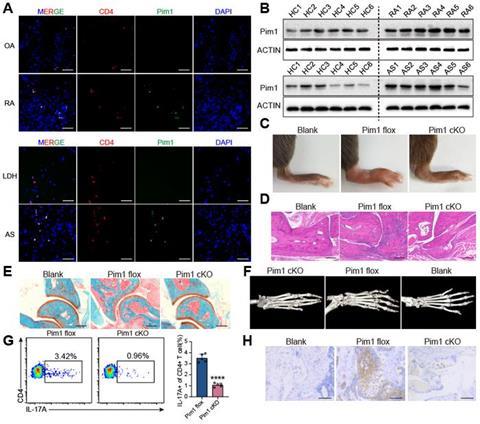
The researchers found that Pim1 protein levels were significantly elevated in CD4⁺ T cells collected from both the peripheral blood and inflamed joints of patients with rheumatoid arthritis and ankylosing spondylitis. Higher Pim1 expression indicated an increased proportion of Th17 cells.
The research focused on Pim1, a serine/threonine protein kinase known to play a role in immune cell signalling
To investigate further, the team created mice with a specific knockout of Pim1 in CD4⁺ T cells, known as Pim1 cKO mice. These animals showed substantially reduced symptoms of inflammatory arthritis compared with normal mice.
The reductions included less joint swelling, decreased inflammatory infiltration and lower levels of cartilage destruction and bone erosion. The researchers also observed a significant decline in the proportion of Th17 cells and reduced expression of the inflammatory cytokine IL-17A.
Mitochondrial metabolism found to play a crucial role
Further analysis revealed how Pim1 influences Th17 cell development.
According to the study, Pim1 promotes mitochondrial calcium influx by phosphorylating mitochondrial calcium uptake protein 1, known as MICU1. This process activates mitochondrial oxidative phosphorylation, providing the energy and metabolic support required for Th17 cell differentiation.
Laboratory experiments demonstrated that increased Pim1 expression significantly enhanced the formation of Th17 cells and boosted the expression of disease-associated genes linked to these cells.
However, these effects were blocked when researchers introduced inhibitors that prevent mitochondrial calcium influx, providing further evidence of the mechanism involved.
Existing drug shows therapeutic promise
Using molecular docking and dynamic simulation techniques, the researchers screened an FDA-approved drug library in search of compounds capable of inhibiting Pim1 activity.
The analysis identified Nilotinib as a specific Pim1 inhibitor. The drug was found to bind stably to the active site of Pim1, suppressing its kinase activity and reducing Th17 cell differentiation.
The analysis identified Nilotinib as a specific Pim1 inhibitor
Animal studies showed that Nilotinib significantly reduced Th17 cell development and alleviated key symptoms of inflammatory arthritis, including joint swelling, inflammatory infiltration, cartilage destruction and bone erosion.
Notably, these beneficial effects were not observed in Pim1 cKO mice, supporting the conclusion that the drug’s therapeutic action depends on Pim1 inhibition.
Future development
The researchers believe that further optimisation of Nilotinib treatment regimens, alongside additional safety and efficacy assessments, could support its future clinical use in inflammatory arthritis.
They also suggest that developing delivery systems capable of targeting Pim1 inhibitors directly to CD4⁺ T cells could improve treatment specificity and broaden therapeutic options for patients with inflammatory arthritis and other Th17-related autoimmune diseases.








No comments yet