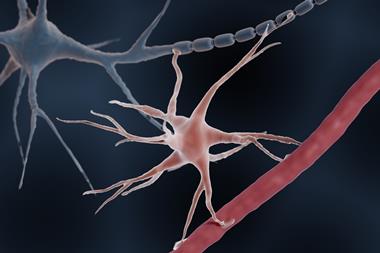
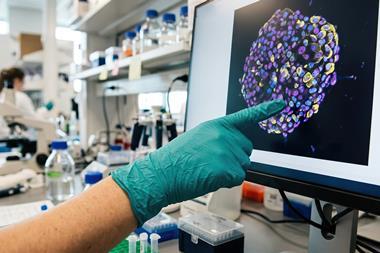
Northwestern scientists have grown human spinal cord organoids to test therapies that could reduce scarring and promote nerve regrowth in patients.
Researchers at Northwestern University have created the most advanced organoid model for human spinal cord injury to date. It is hoped that the model will accelerate the development of new therapies for paralysis.
In the study, the team used lab-grown human spinal cord organoids to replicate different types of spinal injuries and test a promising regenerative treatment.
For the first time, the scientists showed that these organoids could accurately mimic the key effects of spinal cord injury, including cell death, inflammation and glial scarring.
When treated with ‘dancing molecules’ – a therapy that previously reversed paralysis and repaired tissues in animal studies – the injured organoids demonstrated significant growth of neurites, the long extensions of neurons that connect cells. The glial scar-like tissues also diminished noticeably. The findings mean that the therapy, which recently received an Orphan Drug Designation from the US Food and Drug Administration (FDA), could improve outcomes for patients with spinal cord injuries.
“One of the most exciting aspects of organoids is that we can use them to test new therapies in human tissue," said Samuel Stupp, the study’s senior author and the inventor of dancing molecules. “Short of a clinical trial, it’s the only way you can achieve this objective. We decided to develop two different injury models in a human spinal cord organoid and test our therapy to see if the results resembled what we previously saw in the animal model. After applying our therapy, the glial scar faded significantly to become barely detectable, and we saw neurites growing, resembling the axon regeneration we saw in animals. This is validation that our therapy has a good chance of working in humans.”
Tiny organoid, giant leap
Organoids mimic tissue structure, cellular complexity and function, making them better for modelling diseases and testing drugs than animal testing, which is slower and more costly.
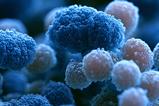
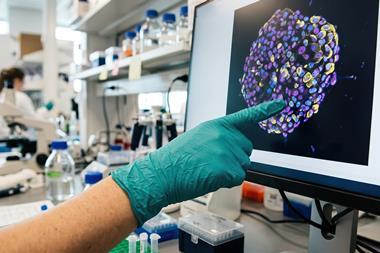
Stupp’s team grew the spinal cord organoids over months, allowing them to develop neurons, astrocytes and, for the first time, microglia – immune cells that respond to injury.
“It’s kind of a pseudo-organ,” Stupp said. “We were the first to introduce microglia into a human spinal cord organoid, so that was a huge accomplishment. It means that our organoid has all the chemicals that the resident immune system produces in response to an injury. That makes it a more realistic, accurate model of spinal cord injury.”
 Fluorescent micrographs showing increased neurite outgrowth from a human spinal cord organoid treated with fast-moving 'dancing molecules' (left) compared to one treated with slow-moving molecules (right) containing the same bioactive signals. Credit: Samuel Stupp/Northwestern University.[/caption]
 The science of ‘dancing molecules’
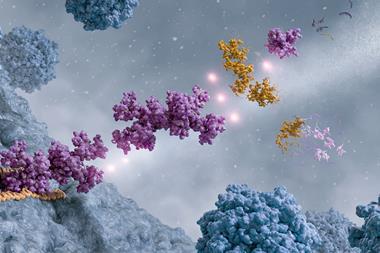
Dancing molecules, introduced in 2021, harness molecular motion to reverse paralysis and repair tissues. Injected as a liquid, they gel into a nanofibre network that mimics the spinal cord’s extracellular matrix. By fine-tuning molecular motion, the therapy connects more effectively with moving cellular receptors.
“Given that cells themselves and their receptors are in constant motion, you can imagine that molecules moving more rapidly would encounter these receptors more often,” Stupp said in 2021. “If the molecules are sluggish and not as ‘social,’ they may never come into contact with the cells.”
Testing a breakthrough therapy
The team modelled laceration and contusion injuries in the organoids, which produced cell death and glial scarring as occurs real injuries. The dancing molecules therapy reduced scarring, calmed inflammation and promoted neurite extension – which restored patterns of neuronal growth.
“Before we even developed the injury model, we tested the therapy on a healthy organoid,” Stupp said. “The dancing molecules spun out all these long neurites on the surface of the organoid but, when we used molecules that had less or no motion, we saw nothing. This difference was very vivid.”
Stupp plans to create even more advanced organoids, including models of chronic injuries, and explore personalised medicine by using a patient’s own stem cells to produce implantable tissue.