Researchers have shown that changing the molecular structure of NK1 receptor antagonists may restore antidepressant effects after decades of failed trials.
For years, scientists have explored the neurokinin-1 receptor (NK1R) as a potential treatment target for major depressive disorder (MDD). Early experimental evidence suggested that blocking this receptor, which is involved in stress and emotional regulation, could produce antidepressant effects. However, optimism waned after several high-profile clinical trials failed to demonstrate consistent benefits. Drugs such as aprepitant, despite promising early data, did not meet expectations in patients, leading many researchers to question whether NK1R was a viable antidepressant target at all.
Now, a new study from Korea University suggests that the failure may not have been due to the biology of the target itself, but rather the chemistry of the drugs designed to act on it.
A fresh look at NK1R antagonists
In research led by Professors Hyeijung Yoo, Hong-Rae Kim and Hyun Kim, scientists have demonstrated that rethinking the molecular design of NK1R antagonists can restore antidepressant-like effects in preclinical models.
Rather than abandoning NK1R, the researchers focused on redesigning the structure of the compounds used to block it.
Rather than abandoning NK1R, the researchers focused on redesigning the structure of the compounds used to block it. Earlier drug candidates frequently shared a chemical feature known as the 3,5-bis-trifluoromethylphenyl (TFMP) group. The team hypothesised that this common structural element may have contributed to inconsistent clinical outcomes.
By removing the TFMP group and replacing it with a structurally distinct scaffold, the researchers identified new NK1R antagonists with markedly different properties.
“Our findings suggest that the structurally distinct antagonists identified in this study exhibit antidepressant-like effects, providing renewed evidence for further exploration of NK1R antagonism as a therapeutic strategy for MDD,” said Professor Hong-Rae Kim, assistant professor in medicinal chemistry at Korea University.
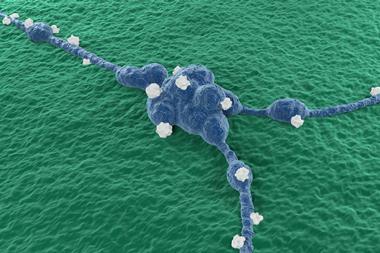
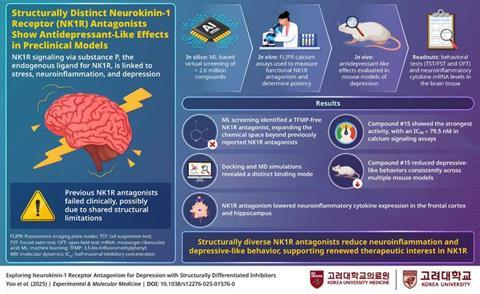
 Machine-learning–guided screening identified a structurally novel NK1 receptor antagonist that reduced depressive-like behaviour and neuroinflammation in mouse models. Credit: Kim Hong-Rae from Korea University.[/caption]
 Machine learning meets drug discovery
To identify suitable candidates, the team employed machine-learning-based virtual screening, analysing millions of molecules to find NK1R antagonists that lacked the TFMP group. Several promising compounds were then synthesised and tested in animal models.
To identify suitable candidates, the team employed machine-learning-based virtual screening, analysing millions of molecules to find NK1R antagonists that lacked the TFMP group.
One molecule, referred to as compound #15, emerged as particularly effective. In mouse models of stress-induced and inflammation-induced depression, the compound reduced depressive-like behaviours and lowered levels of neuroinflammation. Importantly, it did so without affecting locomotor activity, suggesting that the behavioural improvements were not simply due to increased movement or stimulation.
Further analysis showed that compound #15 binds to the NK1 receptor in a way that differs from earlier drugs, supporting the idea that structural diversity can meaningfully alter biological outcomes.
Implications for inflammation-linked depression
The findings may have implications beyond standard depression treatment. Increasing evidence suggests that inflammation contributes to poor antidepressant response in a subset of patients. Structurally novel NK1R antagonists could therefore be explored as treatments for inflammation-associated or treatment-resistant forms of depression.
“Our results provide a foundation for optimising NK1R antagonists and underscore the importance of structural diversity, which could lead to new therapeutic options in treatment-resistant or inflammation-associated depression,” Professor Kim concluded.
Revisiting old targets with new tools
Beyond NK1R specifically, the study highlights a broader strategy in drug development: revisiting previously abandoned targets using modern computational tools and rigorous biological validation. As this research shows, past failures may sometimes reflect limitations in chemical design rather than flaws in the underlying biology, leading to new therapeutic possibilities.


Topics
- Artificial Intelligence (AI)
- Computational Techniques
- Drug Development
- Drug Discovery
- Drug Discovery Processes
- Drug Targets
- G-Protein Coupled Receptors (GPCRs)
- High-Throughput Screening (HTS)
- Hit-to-Lead
- In Vivo Testing
- Korea University
- Machine Learning (ML)
- Medicinal Chemistry
- Neurological disorders
- Neurosciences
- Pharmacology
- Professor Hong-Rae Kim (assistant professor in medicinal chemistry at Korea University)
- Rare & Genetic Disorders
- Small Molecules
- Small Molecules
- Translational Science