Scientists have developed a new class of MRI contrast agents that are both more stable and 30 percent more effective than previous designs.
Researchers at the University of Birmingham have announced a huge advancement in medical imaging technology with a new class of MRI contrast agents. The breakthrough centres on improving the stability of metallo coiled coils – synthetic protein-like structures that show strong potential for enhancing MRI scans, but have been limited due to poor stability.
The new research overcomes this barrier, making these structures viable candidates for clinical use. The findings were conducted in collaboration with scientists from the University of Bristol and Università del Piemonte Orientale whilst also receiving support from the Engineering and Physical Sciences Research Council (EPSRC).
Innovative cross-linking strategy
Led by Professor Anna Peacock, Professor of Bioinorganic Chemistry at the University’s School of Chemistry, the study introduces a covalent cross-linking strategy that reinforces metallo coiled coils. These structures are designed to bind gadolinium, a metal commonly used in MRI contrast agents, offering a new approach that significantly improves both performance and safety.
The study introduces a covalent cross-linking strategy that reinforces metallo coiled coils.
“We’ve developed a new class of MRI contrast agents that are significantly more efficient than current clinical agents, and we’ve now made them stable,” said Professor Peacock. “By locking metal-binding peptides into place with molecular cross-links, we've engineered MRI contrast agents that are not only more stable but also deliver a further 30 percent improvement in effectiveness compared to their non-crosslinked counterparts. The modular nature of these designs paves the way for safer, smarter imaging in clinical diagnostics."
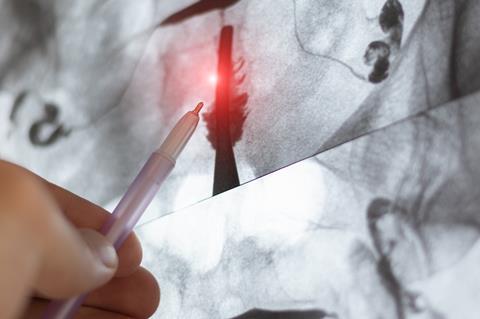
 Contrast agents, like those shown enhancing visibility in these X-ray scans above, are essential for medical imaging. The new University of Birmingham study has developed a next-generation MRI contrast agent offering greater stability and precision than ever before.[/caption]
 Enhanced performance and stability
The team reported that the cross-linked agent demonstrated a 30 percent increase in MRI relaxivity compared with its non-cross-linked counterpart, which is expected to improve image clarity at clinically relevant magnetic field strengths. Additionally, the research showed an unprecedented enhancement in both chemical and biological stability.
Further experiments explored the agents’ performance in Seronorm, a human serum matrix, to assess potential interactions with endogenous biomolecules. The agents retained their bio-inertness and structural resilience, closely matching the results obtained in aqueous solution. This suggests there is a strong potential for in vivo applications in the future.
Patents and future prospects
The University of Birmingham’s Enterprise division has filed a patent application for the novel metallo coiled-coil approach. Researchers are actively seeking licensing or development partners from industry to advance the technology towards clinical use.
Beyond MRI, the covalent cross-linking strategy could have broader applications.
Beyond MRI, the covalent cross-linking strategy could have broader applications. By enhancing stability and providing precise control over metal coordination environments, the approach offers potential in catalysis, sensing and materials science, potentially allowing for a range of innovative scientific and industrial uses.
A step forward for safer, smarter imaging
This development represents a significant step forward in creating more effective and safer MRI contrast agents. By combining chemical innovation with a practical focus on clinical uses, this research has moved science towards a more accurate and reliable medical imaging system, with potential benefits across healthcare and beyond.



Topics
- Cancer
- Companies
- High-Throughput Screening (HTS)
- Imaging & Diagnostics
- Magnetic Resonance Imaging (MRI)
- Molecular Biology
- Nanomedicine
- Nanotechnology
- Professor Anna Peacock (Professor of Bioinorganic Chemistry at the University’s School of Chemistry)
- Protein Expression
- Research and development
- Structural Biology
- the Engineering and Physical Sciences Research Council (EPSRC).
- the University of Birmingham
- the University of Bristol
- Translational Science
- Università del Piemonte Orientale