



Insilico Medicine has announced ISM9528, a potential first-in-class non-opioid therapy for chronic pain, has demonstrated superior preclinical efficacy to morphine and pregabalin and a favourable safety profile.

Insilico Medicine has nominated a new preclinical drug candidate for chronic pain that demonstrated efficacy comparable to, and in some preclinical models exceeding, existing treatments including morphine, marking another milestone for the company’s generative artificial intelligence-driven drug discovery platform.
The clinical-stage biotechnology company has announced ISM9528 as its 31st preclinical candidate compound (PCC) since 2021. The orally available, brain-penetrant therapy is designed to target a previously unexplored biological mechanism associated with chronic pain, offering a potential first-in-class, non-opioid treatment option.
The announcement comes at a time of growing demand for alternative pain therapies. More than one in five people globally are estimated to live with chronic pain, while current standards of care remain heavily dependent on opioids and non-steroidal anti-inflammatory drugs, both of which are associated with significant limitations including addiction risk, gastrointestinal toxicity and inconsistent efficacy.
AI identifies a new therapeutic target
Insilico used its PandaOmics artificial intelligence platform to identify and prioritise a previously unrecognised biological target linked to pain. By analysing extensive omics, textual and multimodal datasets, the platform highlighted the potential of Target Z, which had not previously been systematically associated with pain management.
Subsequent bioinformatics analysis of human and animal data revealed high expression of Target Z in pain-related cell types, prompting further laboratory investigation. The company then used its Chemistry42 generative chemistry platform to optimise compounds for brain penetration, efficacy and safety before selecting ISM9528 as the programme’s lead candidate.
Subsequent bioinformatics analysis of human and animal data revealed high expression of Target Z in pain-related cell types, prompting further laboratory investigation
“To see a non-opioid candidate outperform morphine in preclinical models is an unprecedented milestone, perhaps one of the most remarkable and unexpected results in our company’s history, a result of frontier AI, human ingenuity and scientific serendipity,” said Dr Alex Zhavoronkov, Founder, CEO and CBO of Insilico Medicine. “Target discovery for highly complex human mechanisms like chronic pain and migraine historically takes over a decade, but PandaOmics precisely mapped this pathway, driving us to our 31st PCC since 2021. By understanding the biology behind, we are not only addressing pain management, but moving one step closer to our ultimate ambition: decoding the biology of ageing through our dual-purpose strategy.”
Promising preclinical results
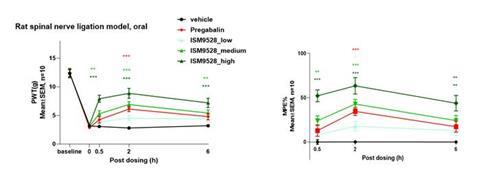
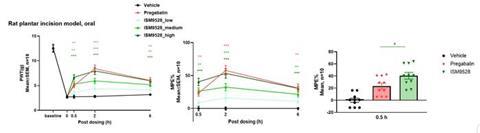
According to the company, ISM9528 demonstrated superior efficacy to current standards of care in validated models of both acute postsurgical pain and neuropathic pain when administered orally.
In a spinal nerve ligation rat model of neuropathic pain, the candidate restored mechanical allodynia in a dose-dependent manner, with the middle dose producing analgesic effects comparable to pregabalin for up to six hours after dosing. In a separate postsurgical pain model, ISM9528 also showed rapid pain relief within 30 minutes of administration, outperforming an equivalent dose of pregabalin.
ISM9528 demonstrated superior efficacy to current standards of care in validated models of both acute postsurgical pain and neuropathic pain when administered orally
Alongside efficacy, the candidate demonstrated favourable safety characteristics during in vitro and in vivo testing, while rapid systemic absorption and strong blood-brain barrier permeability supported its pharmacokinetic profile.
The programme also represents another demonstration of Insilico’s accelerated AI-enabled research model. While conventional early-stage drug discovery often takes between two-and-a-half and four years, the company says it has consistently progressed programmes from target identification to PCC nomination within 12 to 18 months.
AI platform continues to accelerate drug discovery
The nomination of ISM9528 is the 31st preclinical candidate generated by Insilico since 2021, further demonstrating the company’s AI-driven research and development capabilities. Of those candidates, 13 have already received Investigational New Drug (IND) approval or clearance, highlighting the speed with which the platform is advancing programmes towards clinical testing.
“The nomination of ISM9528 as the 31st drug candidate of Insilico validates the reproducibility and precision of our end-to-end AI platform,” said Dr Feng Ren, Co-CEO and CSO of Insilico Medicine. ”Featuring both a novel mechanism of action and a highly distinct chemical structure, ISM9528 delivers superior efficacy and a favourable safety profile, with promising brain penetrant traits. Looking ahead, we are confident that our continuous integration of generative AI and automation will set new standards, deliver solid proof of concept and introduce real-world clinical benefits for patients.”
The company is now preparing to advance the programme into human clinical studies, with first trials planned for 2027.









No comments yet