



Researchers at Peking Union Medical College Hospital have used single-cell sequencing to uncover an AGR2-high tumour cell subcluster linked to aggressive behaviour in NF-PanNETs, while identifying the transcription factor FOXM1 as a key driver of proliferation and a candidate target for therapeutic intervention.
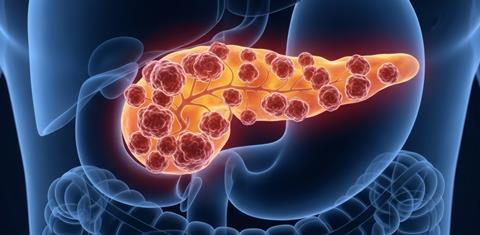
Researchers have identified a potential new way to predict outcomes in patients with non-functional pancreatic neuroendocrine tumours (NF-PanNETs), a group of cancers known for their highly variable behaviour.
Although almost 90 percent of NF-PanNETs are diagnosed as WHO grade 1 or 2, patients with tumours in the same grade can experience very different outcomes. Some tumours remain localised and grow slowly while others progress rapidly or spread to other parts of the body.
A new study, led by Yupei Zhao’s team at Peking Union Medical College Hospital in collaboration with Zhixiang Lin at The Chinese University of Hong Kong and Jianhui Wu at Peking University Cancer Hospital, investigated the cellular differences that may help explain this variation.
The researchers used single-cell RNA sequencing from 10 patients, single-cell chromatin accessibility sequencing from four patients and bulk RNA sequencing from 77 patients. They identified an AGR2-high endocrine cell subcluster that was enriched in high-grade tumours.
These AGR2-high cells showed several features associated with malignant behaviour, including higher copy-number variation scores, increased proliferative activity and enrichment of a metastasis-like primary tumour signature.
Potential prognostic marker
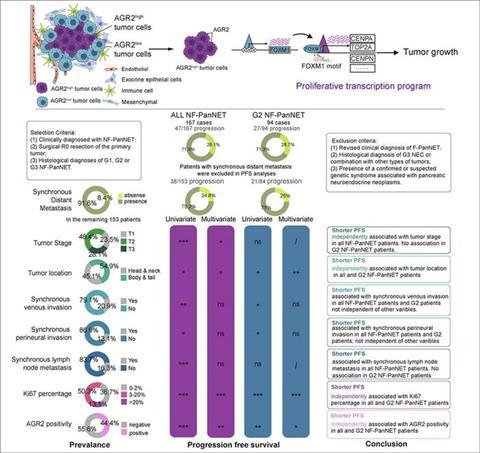
The team then examined the clinical significance of AGR2 in a two-centre cohort of 167 patients who had undergone surgery for NF-PanNETs.
AGR2-positive tumours were associated with larger tumour size, higher WHO grade and a greater frequency of synchronous metastasis. Among patients without synchronous distant metastasis, those with AGR2-positive tumours also had significantly shorter progression-free survival.
The findings suggest that AGR2 immunohistochemistry could provide a relatively simple way to help assess prognosis in NF-PanNETs, including among patients with grade 2 tumours where outcomes can vary considerably.
FOXM1 as a key therapeutic target
The researchers also sought to understand what drives the aggressive AGR2-high cell state.
Single-cell chromatin analysis identified the transcription factor FOXM1 as a key regulator. Further experiments showed that FOXM1 directly controls genes involved in cell division, including CENPA, CENPN, PLK1, CDCA2 and TOP2A. This activity promotes the proliferative transcriptional programme observed in AGR2-high cells.
Disrupting FOXM1 reduced NF-PanNET tumour growth in further experiments. The FOXM1 inhibitors FDI-6 and thiostrepton also demonstrated therapeutic effects in tumour cells, patient-derived organoids and xenograft models.
Together, the findings identify AGR2 as a potential tool for improving prognostic stratification in NF-PanNETs and point to FOXM1 as a potential therapeutic vulnerability.
The researchers say the results could help address the challenge of predicting which apparently lower-grade NF-PanNETs are likely to behave more aggressively, while providing a possible basis for developing targeted treatments for these tumours.














No comments yet