



New research has identifies elevated IL-17 activity in approximately 5 percent of clear cell ovarian cancer cases, with findings suggesting the inflammatory protein may convert immunologically ‘cold’ tumours into environments receptive to immune checkpoint inhibition.

Researchers have identified a small subtype of clear cell ovarian cancer that may respond to immunotherapy, challenging the long-held view that the disease is largely resistant to immune-based treatments.
The study was led by Kosuke Murakami from Kindai University Faculty of Medicine and Noriomi Matsumura, Head of the university’s Department of Obstetrics and Gynecology, alongside collaborators Shiki Takamura of the RIKEN Center for Integrative Medical Sciences and researchers at Kindai University.
The research combined analysis of human tumour samples with experiments in mice and cultured cancer cells, identifying the inflammation-related protein IL-17 as a potential marker of immunotherapy response and revealed a mechanism through which it may alter the tumour environment.
Small cancer subtype shows immune activity
The researchers analysed tissue samples and genetic data from 180 cases of human clear cell ovarian cancer. Although these tumours generally contained relatively few immune cells, approximately 5 percent showed high levels of IL-17 activity.
These cancers displayed an inflammatory signature, with increased infiltration and activation of immune cells within the tumour microenvironment.
The researchers analysed tissue samples and genetic data from 180 cases of human clear cell ovarian cancer
The researchers said the IL-17-related characteristics emerged independently of markers traditionally used to predict immunotherapy response, suggesting that the protein could potentially serve as a new biomarker for identifying patients who may benefit from immune checkpoint inhibitors.
Clear cell ovarian cancer is considered particularly difficult to treat because it tends to be resistant to anticancer drugs. It is also more common in Japan than in Western countries, accounting for around one-quarter of ovarian cancers there.
IL-17 may transform ‘cold’ tumours
The team then used a mouse model designed to replicate human clear cell ovarian cancer alongside cultured cancer cells to investigate how IL-17 affects tumours.
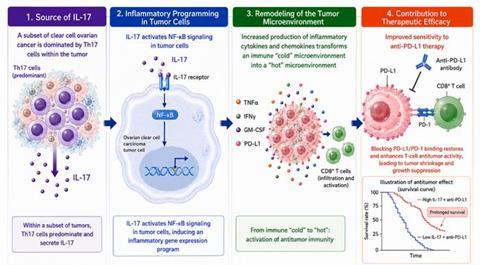
The experiments indicated that IL-17 acts directly on cancer cells, activating the inflammatory signalling pathway NF-κB. This caused the cancer cells to release substances capable of attracting and activating immune cells.
The experiments indicated that IL-17 acts directly on cancer cells, activating the inflammatory signalling pathway NF-κB
When researchers established an environment in which IL-17 activity was increased in mice, tumours showed greater immune-cell infiltration and activation. The animals also responded more strongly to anti-PD-L1 immunotherapy and had longer survival.
The findings indicate that IL-17 could help to transform an immunologically ‘cold’ tumour, which contains relatively few immune cells, into an environment where the immune system is better able to recognise and attack cancer cells.
Potential biomarker for personalised treatment
The researchers said identifying tumours with high IL-17 activity could eventually help predict which patients with clear cell ovarian cancer are most likely to benefit from immunotherapy.
However, the findings remain at the research stage. While the study included human tumour data, the experiments demonstrating the mechanism and improved response to anti-PD-L1 treatment were conducted in mice and cultured cells.
These findings could contribute to more personalised approaches to treating clear cell ovarian cancer by helping identify patients whose tumours are more likely to respond to immune-based treatment.
Further research will be needed to determine whether IL-17 activity can be validated as a reliable clinical biomarker and whether targeting this mechanism can improve outcomes for patients in clinical trials.










No comments yet