



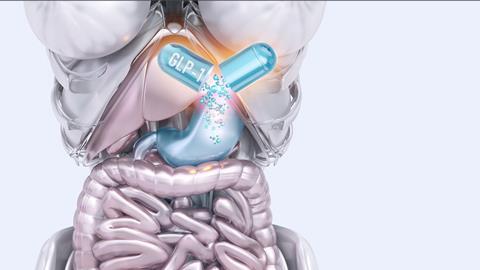
As the GLP-1 market surpasses $130 billion in annual sales, BioLife’s newly patented effervescent tablet technology aims to address one of peptide drug development’s most persistent scientific obstacles – reliable oral delivery and systemic absorption.
BioLife has been granted US Patent 12,667,605 B2 by the United States Patent and Trademark Office for its effervescent oral peptide delivery technology, developed internally under the name OralMatrix.
The patent comes at a time when the pharmaceutical industry is investing heavily in peptide medicines, particularly GLP-1 therapies for obesity and diabetes. GLP-1 therapies generated approximately $132 billion in global sales in 2025 while obesity medicines now represent an estimated $42 billion market.
But the commercial success of these medicines does not remove one of the fundamental scientific problems associated with peptides: oral delivery.
Unlike many conventional small-molecule drugs, peptides can be vulnerable to degradation in the gastrointestinal tract. Their larger molecular structures can also make it difficult for them to cross biological membranes and reach the bloodstream in sufficient quantities.
That creates a challenge for drug developers, as a molecule may show promising biological activity in laboratory or injectable studies, yet prove much harder to develop as an oral medicine.
Finding ways to protect peptides during their passage through the digestive system could therefore influence not only existing GLP-1 medicines but also future peptide programmes.
Why are peptides difficult to take by mouth?
Peptides are relatively large biological molecules. This can make them more susceptible to breakdown by digestive enzymes and can limit their ability to cross the intestinal lining.
The stomach and intestine are chemically active environments. A formulation therefore needs to protect the peptide long enough for an active form of the molecule to reach a site where it can be absorbed.
Absorption is another major hurdle. Even if a peptide survives digestion, only a fraction may cross into the bloodstream.
For drug developers, the challenge is to balance protection, release and absorption while maintaining a formulation that can ultimately be manufactured and administered reliably.
How does this fit with what is already happening in the field?
The development of oral GLP-1 medicines has already demonstrated that the injection-free delivery of peptide therapies is possible. It has also highlighted the complexity of achieving effective oral exposure.
BioLife is pursuing a different strategy from approaches that rely on specialised coatings or absorption-enhancing ingredients.
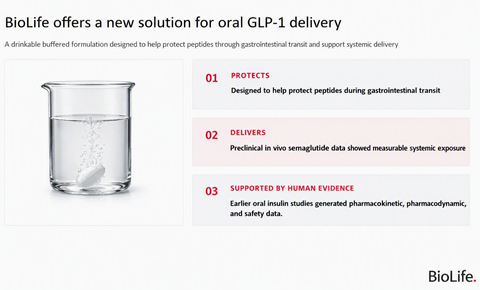
Its technology uses a dissolvable effervescent tablet designed to create a gastric buffer. The company says this environment is intended to help protect peptide therapeutics as they pass through the digestive system and support their absorption.
The underlying idea is significant because oral peptide delivery is not simply a question of making a tablet that contains the active ingredient. The formulation has to address several barriers between the mouth and systemic circulation, including the harsh conditions of the gastrointestinal tract and the difficulty peptides face when crossing the intestinal barrier.
What does it mean for researchers working in this area?
The immediate significance of BioLife’s patent is intellectual property protection rather than evidence of a new approved medicine.
Preclinical studies reported by the company have demonstrated measurable systemic semaglutide exposure following oral administration, providing what BioLife describes as in vivo proof of concept.
The granted US claims extend across several GLP-1 medicines, including semaglutide, liraglutide, dulaglutide, albiglutide, exenatide and lixisenatide. Patent protection runs into 2042, with further applications pending internationally.
For researchers, the more important question will be whether the underlying delivery approach can consistently translate preclinical exposure into clinically meaningful drug levels and therapeutic effects.
The company’s development programme builds on nearly 20 years of research, including human clinical studies involving oral insulin formulations and collaborations with Charles River Laboratories, SGS, Eurofins/Amatsi and Cephac.
That development history provides context for the technology, but further evidence will be needed to establish its performance across different peptide molecules, doses and patient populations.
What happens next?
The next stage will be transitioning from proof of concept towards clinical development and, ultimately, regulatory assessment.
Researchers and drug developers will be looking for evidence on how effectively the technology protects different peptide molecules, how much active drug reaches systemic circulation and whether that exposure is sufficient to produce a predictable therapeutic response.
The broader question is also whether an approach developed around today’s GLP-1 medicines can become a platform for future peptide therapeutics.
That could prove important as the field moves past the current generation of obesity and diabetes drugs. More sophisticated peptide medicines are being explored across metabolic disease and other therapeutic areas, increasing the potential value of delivery technologies that can overcome the limitations of conventional oral administration.
For now, BioLife’s patent represents a step in that direction rather than a finished treatment. Its significance lies in the problem it is attempting to solve: making large biological molecules behave more like practical oral medicines.
GLP-1 medicines have changed how obesity and metabolic disease are treated, but we still need better oral options. This patent represents much more than protection for a formulation. It reflects decades of scientific work focused on addressing on the most important challenges in peptide medicine: helping these molecules pass through the digestive system intact, for today’s therapies and for future generations of peptide therapeutics.”
Dr Farid Bennis, Founder of BioLife and inventor of the technology known internally as OralMatrix
Key takeaways
-
The news – BioLife has received US patent protection for its effervescent oral peptide delivery technology.
-
The scientific challenge – Peptides can be degraded in the gastrointestinal tract and are difficult to absorb orally.
-
The approach – BioLife uses a dissolvable effervescent tablet designed to create a gastric buffer around the peptide.
-
The evidence so far – Preclinical studies have reported measurable systemic exposure to orally administered semaglutide.
-
What to watch – Clinical data will be important in determining whether the technology can deliver consistent and therapeutically meaningful peptide exposure.
-
The wider opportunity – If successful, improved oral delivery could potentially support both current GLP-1 medicines and future generations of peptide therapeutics.








No comments yet