


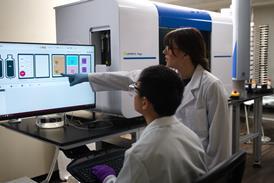


What if researchers could design therapeutic antibodies instead of relying on screening millions of candidates? Generative AI is making this increasingly possible, offering new ways to tackle challenging targets.
For decades, finding a therapeutic antibody has been a numbers game. You build a huge library, screen it, pull out the binders and spend months optimising the few that look promising. It works, and it has given us many of today’s antibody drugs. But it’s slow, and it leaves a lot to chance.
Generative AI is starting to change that. Instead of searching for good antibodies, researchers can now design them around the properties they actually need, then go to the lab to confirm their performance.
In a recent perspective, Noh and Yoo (2026) describe this as a move from empirical screening to specification-driven engineering. The idea isn’t to replace the lab. It’s to bring computation, design and experimental testing together much earlier in the process.
Why the traditional approach hits a wall
The classic workflow is sequential. Immunise or build a library, screen for binders, then optimise and characterise the best hits.
The problem is scale. A library can hold millions or even billions of variants, yet screening only samples a small fraction of them. Every round of selection, sequencing, expression and testing adds more time and cost.
Binding is just the first hurdle. A real therapeutic also needs specificity, stability, good expression and manufacturability. These properties often pull against each other: fix one and another gets worse. As screening selects for binding first, issues like aggregation or poor formulation stability tend to show up late. By then, the fix might mean more engineering or going all the way back to discovery.
What AI brings to the table
AI changes the order. Rather than screening first and optimising later, researchers can design sequences or rank candidates based on the properties they care about from the start.
A few approaches are leading the way:
- Protein language models, trained on huge amounts of sequence data, suggest mutations likely to improve an antibody.
- Structure-based generative models use molecular geometry to design antibodies against specific epitopes.
- Machine learning models learn from experimental binding and characterisation data, potentially improving with each design cycle.
By considering affinity, specificity, stability and developability early in the process, researchers can potentially reduce the number of candidates requiring laboratory testing.
The results so far are striking. In one study, Hie et al. (2024) used protein language models to guide affinity maturation for seven human antibodies. All seven improved after just two rounds of lab evolution, with as few as 20 variants tested per antibody. Results will vary by target, training data and design goals, but that’s a dramatic cut in experimental work.
Opening doors to harder targets
AI isn’t just speeding up existing workflows. It’s also making difficult targets more approachable.
Take G protein-coupled receptors (GPCRs). They sit in the cell membrane, shift between conformations and have long frustrated antibody developers. Conventional methods often find antibodies that bind an accessible region of the receptor but don’t produce the desired functional effect.
Geometry-aware generative models can help here by building structural information into the design itself. Researchers can target binding sites that match a specific receptor conformation or surface. The same thinking is now being applied to antibodies designed to cross the blood-brain barrier, where receptor binding, intracellular trafficking and release all influence how effectively the antibody is delivered.
The lab still has the final say
For all its promise, AI can’t fully model biology. Membranes, conformational dynamics and complex molecular interactions are still beyond what any model can fully capture. The only way to know if an AI-designed antibody works is to make it and test it.
That’s why closed-loop discovery is gaining traction. Models propose candidates, the lab tests them and the data goes back into the next round of design. Every result counts, including the failures. Negative data is underrepresented in antibody datasets, and that gap limits how well models generalise.
Keeping pace with AI design
As design gets faster, the lab becomes a bottleneck. AI can generate thousands of sequences in the time it takes to express a handful. To keep the design-build-test-learn cycle moving, experimental data has to come back quickly.
That’s where Biointron’s RushData platform comes in. Built on our one-day transient CHO expression system, with capacity for more than 20,000 molecules per week, RushData takes you from sequence to high-quality wet-lab data in days. Expression, binding analysis and optional early developability profiling all run in one standardised workflow, giving you structured datasets ready for model training, validation and optimisation.
Learn more about RushData →











No comments yet