Researchers have identified a biological pathway linking sugar and appetite for alcohol, suggesting that rare sugars could one day form the basis of new therapies and approaches for reducing alcohol consumption and treating dependence.
Researchers at Kyoto University have discovered that a biological system known for regulating sugar appetite may also play a key role in controlling alcohol intake, raising the possibility of new therapies and approaches for preventing and treating alcohol dependence.
The discovery came from investigations into the FGF21-oxytocin-dopamine system, a hormonal and neural pathway that helps regulate appetite for sugar. While studying this mechanism, the team noticed earlier reports suggesting that the protein fibroblast growth factor 21 (FGF21) might also influence alcohol consumption. Given that alcohol is produced through the fermentation of sugar, the researchers hypothesised that the body may process sugar and alcohol as related substances.
A global health challenge
Excessive alcohol consumption is a major global health issue, with limited effective options for prevention and treatment. Pharmaceutical therapies for alcohol dependence often suffer from poor patient adherence, partially because they reduce the pleasure associated with drinking. Many patients therefore avoid drug-based treatments altogether.
Excessive alcohol consumption is a major global health issue, with limited effective options for prevention and treatment.
“It was important that any intervention provide pleasure and act as a substitute for alcohol,” says corresponding author Sho Matsui. “We imagined that some functional sugars may be able to fill that role.”
This insight prompted the team to explore whether certain food ingredients could activate the same biological pathways involved in regulating alcohol intake, without eliminating enjoyment.
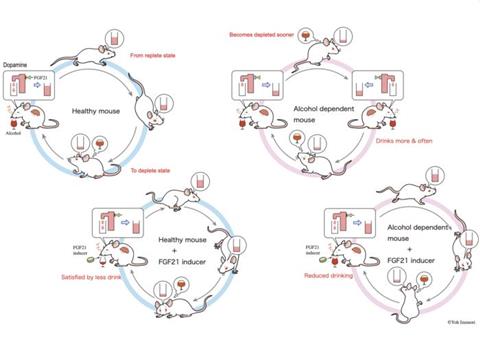
 How the FGF21-oxytocin-dopamine system regulates alcohol consumption. Credit: Yoh Izumori.[/caption]
 Modelling alcohol dependence
To test their theory, the researchers developed a new experimental protocol to model alcoholism in mice. Using this model, they examined how different food ingredients known to induce FGF21 affected the animals’ drinking behaviour.
Their experiments revealed that the FGF21-oxytocin-dopamine system normally acts as a signal of satiety for alcohol consumption. In alcohol-dependent mice, however, this system was found to be down-regulated, leading to excessive drinking. When the researchers stimulated the pathway using FGF21-inducing food ingredients – specifically rare sugars – alcohol consumption fell significantly in both healthy mice and those with alcohol dependence.
Rethinking alcohol dependence
The findings suggest that alcohol dependence may not be solely a disorder of substance abuse or conscious behaviour. Instead, it may also stem from disruptions in subconscious information processing within the central nervous system, mediated by FGF21 metabolic signalling.
The findings suggest that alcohol dependence may not be solely a disorder of substance abuse or conscious behaviour.
By targeting this pathway with functional dietary ingredients, it may be possible to regulate alcohol intake in a more acceptable and sustainable way than current drug treatments.
“Dietary therapy is effective in controlling appetite if you can stick to it, but most can’t. The same applies to over-drinking,” said team leader Tsutomu Sasaki. “Our work demonstrates that there is a subconscious inter-organ crosstalk signal that regulates appetite for alcohol.”
From mice to humans
The researchers caution that further work is needed before the approach can be applied clinically. Their next steps include confirming whether the same mechanisms operate in humans and developing practical food and drink products designed to reduce alcohol consumption.
Potential applications include dietary supplements, nutraceuticals and non-alcoholic beverages formulated to stimulate FGF21. In parallel, the team is also exploring the development of a potent FGF21-inducing drug.
If successful, the research could add a new powerful method for addressing alcohol dependence – one that works with the body’s own appetite-regulating systems rather than against them.