Researchers have developed new innovative fluorescent labels that allow scientists to observe cellular processes with unprecedented clarity – offering a powerful tool for medicine, drug research and cell biology.
Researchers at IOCB Prague have developed a new type of fluorescent label that enables unparalleled clarity when monitoring processes within living cells, including responses to drugs and changes in cellular structures. The study could aid the advancement of research across medicine, the pharmaceutical industry and other life sciences.
The research was led by Milan Vrábel and Tomáš Slanina of IOCB Prague, in collaboration with the chemical biology group of Péter Kele in Hungary.
Targeted fluorescence reduces background noise
Traditional fluorescent dyes often bind non-specifically, causing entire cells to glow and making it difficult to pinpoint the areas of interest. This also requires repeated washing to remove excess dye, increasing time and costs. The newly developed labels overcome these limitations by fluorescing only when bound to the intended target molecule.
Traditional fluorescent dyes often bind non-specifically, causing entire cells to glow and making it difficult to pinpoint the areas of interest.
This eliminates the need to repeatedly wash cells to remove excess fluorescent dye. With conventional methods, dyes often attach to unintended sites, making observations more difficult and the process more costly. The entire cell can end up fluorescing, which makes it very challenging to pinpoint the exact area of interest.
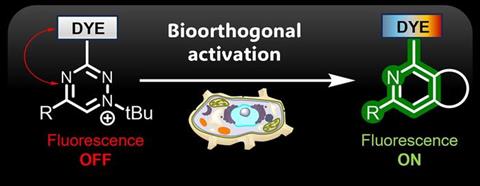
By employing fluorogenic triazinium probes, the team created labels that remain non-fluorescent until a specific chemical reaction triggers fluorescence at the desired site. Triazinium salts suppress unwanted signals, allowing researchers to visualise only the processes they want to study.
“A significant advantage of the new technology is its versatility,” says IOCB Prague postdoctoral researcher and first author of the study, Veronika Šlachtová. “Our method works across the visible spectrum, from blue to far red. Thanks to labels of different colours, we can monitor several cellular structures simultaneously within a single experiment.”
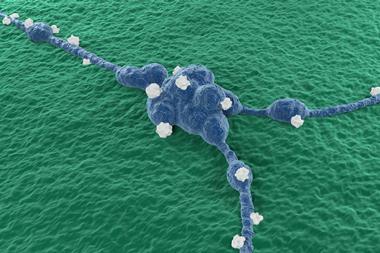
 The picture illustrates the overall fluorescence quenching effect of triazinium salts, which can be turned on through biocompatible reactions. Credit: Veronika Šlachtová et al.[/caption]
 Applications in biology and medicine
Fluorescence microscopy is a key technique in modern biology, medicine and pharmaceutical research. It allows scientists to observe processes such as protein movement, the effects of drugs and changes in cellular structures in real time. The new fluorescent labels are also suitable for studying carbohydrate structures on cell surfaces, which are key in immune responses, infections and cancer metastasis.
High-quality and reliable fluorescent labelling facilitates everyday work in the laboratory while also providing higher-quality data.
“High-quality and reliable fluorescent labelling facilitates everyday work in the laboratory while also providing higher-quality data,” says Dr Milan Vrábel, corresponding author of the study. “In the long term, it may accelerate drug testing or enable more precise monitoring of molecular processes in cells.”
Thanks to their high sensitivity, ease of preparation and broad colour spectrum, the new fluorogenic probes have the potential to become standard tools in research laboratories, helping scientists gain a clearer view of cellular mechanisms and potentially leading to new advances in medicine and drug development.



Topics
- 3D Cell Cultures
- Analytical Techniques
- Assays
- Biopharmaceuticals
- Cancer
- Cell-based Technologies
- Companies
- Czech Academy of Sciences (IOCB Prague)
- Disease Research
- Dr Milan Vrábel (Group leader at IOCB Prague)
- Drug Delivery
- Drug Development
- Drug Discovery
- Drug Discovery Processes
- Drug Targets
- Drugs and therapies
- High-Throughput Screening (HTS)
- Imaging & Diagnostics
- Microscopy
- Molecular Biology
- Neurological disorders
- Precision Medicine
- Translational Science
- Veronika Šlachtová (postdoctoral researcher at IOCB Prague)