



A USC-led team has combined single-cell developmental mapping with synthetic biology to produce kidney organoids that more faithfully recapitulate human embryonic kidney formation.

Scientists at the University of Southern California (USC) have developed a new technique that could make lab-grown kidney tissue more accurate and reliable for studying disease, testing new treatments and supporting the creation of transplantable organs.
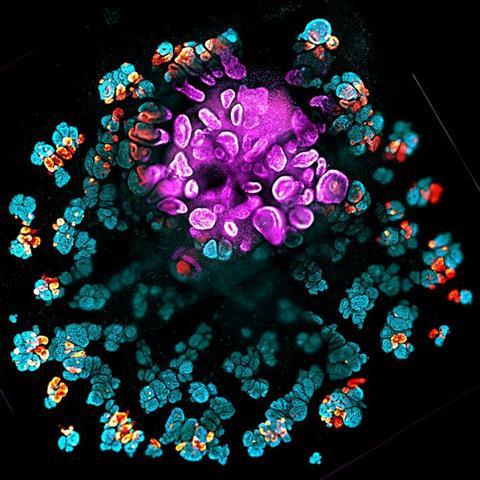
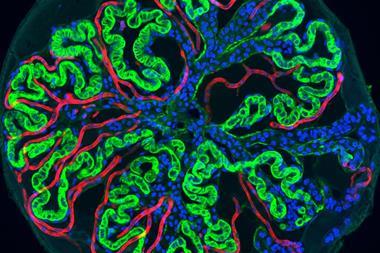
The research combines a biological discovery with a new engineering approach to improve kidney organoids. By mapping the development of the human kidney, the team identified a previously unknown developmental axis that helps organise the kidney’s filtering units, known as nephrons. They then created engineered ’synthetic organiser’ cells that recreate part of the natural developmental environment inside kidney organoids, resulting in structures that more closely resemble those found in the developing human body.
“It is important that we’re starting to get good reproducibility from organoid models that can lead to robust preclinical models of cell function and disease to benefit patients,” said the paper’s co-corresponding author Dr Nils Lindström, Assistant Professor of Stem Cell Biology and Regenerative Medicine at the Keck School of Medicine of USC.
Mimicking natural development
For more than a decade, scientists have relied on stem cells’ natural ability to self-organise into tissue-like structures by exposing entire organoids to chemical signals. The USC team instead introduced a small cluster of engineered cells that produces controlled amounts of Wnt proteins, key developmental signals that naturally guide kidney formation.
For more than a decade, scientists have relied on stem cells’ natural ability to self-organise into tissue-like structures by exposing entire organoids to chemical signals
Rather than overriding the cells’ natural behaviour, the synthetic organiser provides a localised source of signals that directs development in a way that more closely mirrors how kidneys form in embryos.
“With our approach, we are trying to control self-organisation and work with it as opposed to try to completely override it,” said co-corresponding author Dr Leonardo Morsut, Associate Professor of Stem Cell Biology and Regenerative Medicine and Biomedical Engineering at the Keck School of Medicine and USC Viterbi School of Engineering.
Discovering a new developmental pathway
The project began when researchers engineered synthetic organiser cells capable of releasing Wnt proteins before testing their effect on developing kidney tissue.
The experiments showed that the localised signal not only influenced what the developing cells became but also directed how the structures physically formed. Nephrons elongated towards the Wnt source, closely matching the pattern seen during natural kidney development.
“A single, localised signal did two things at once. It changed what the cells became and physically pulled the tubules toward the source,” Dr Lindström said. “You would not see that with a uniform chemical bath of signals.”
The experiments showed that the localised signal not only influenced what the developing cells became but also directed how the structures physically formed
The researchers also identified what they describe as a previously unrecognised developmental axis in the human kidney. While scientists have long understood the nephron’s traditional proximal-distal axis, the newly discovered axis is determined by each nephron’s proximity to the collecting duct, which releases Wnt signals that influence both structure and orientation.
“The study shows that there’s an undiscovered axis that sets up how a nephron looks and forms,” said Dr Lindström. “It’s not every day that you find something new in human development at that level.”
Supporting future therapies
Most existing kidney organoids lack collecting ducts, meaning they also lack this developmental axis. By recreating the signalling environment using synthetic organiser cells, the researchers produced organoids that were both more reproducible and more representative of natural human kidney development.
Dr Morsut believes the technology could help scientists gain greater control over how complex tissues form in the laboratory.
Most existing kidney organoids lack collecting ducts, meaning they also lack this developmental axis
“The synthetic organiser is just a little cluster of cells that don’t build anything themselves,” said Dr Morsut. “But they produce a powerful field that aligns the stem cells and gives them a direction.”
Reflecting on the wider significance of the work, he added: “At the beginning of my talks, I always show a video of embryonic development. You start from a single cell and you get to a complete organism, and that’s as close to magic as it gets. Now, we open a possibility of controlling this magic technology for building organs. This study shows that we can do that and I’m excited to see what others will do in other contexts.”





No comments yet