




Static cultures may not tell the whole story when it comes to immunotherapy performance. Results from the Mera™ flow-based human tissue model show stronger T-cell activity and cytokine responses under physiological flow, highlighting the role of dynamic immune–tumour interactions in preclinical testing.
Introduction
Predicting immunotherapy response preclinically remains a major challenge in drug development, largely due to the limitations of static in vitro systems. Flow-based human tissue models, such as Mera, aim to address this by capturing dynamic immune–tumour interactions under physiologically relevant conditions.
Results from Mera – a flow-based platform
In a flow-based model, the bispecific T-cell engager (BiTE) blinatumomab induces higher levels of targeted cancer cell death and elevated cytokine release, compared with a static culture. Continuous circulation, which matches physiological flow more closely, enabled enhanced cancer cell–immune interactions resulting in improved immune cell responses.
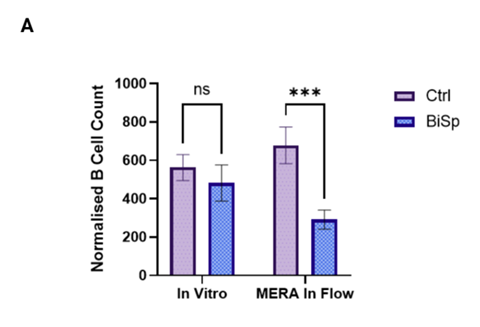
This effect is evident in Figure 1A, where blinatumomab demonstrates markedly enhanced cytotoxic activity under flow conditions compared with static in vitro culture. No statistically significant difference (ns) is observed between control and treatment in static conditions (~1.1-fold decrease). In contrast, under Mera flow conditions, a highly significant (>2-fold) reduction in B-cell count (***p < 0.001) is observed, indicating BiTE-induced B-cell killing in the flow-based system, driven by increased immune–target interactions.
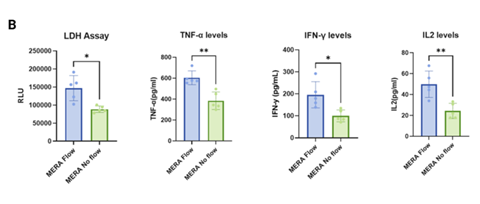
Figure 1B further supports these findings, showing an approximately 1.7-fold increase in lactate dehydrogenase (LDH) release under flow compared to no-flow conditions. As LDH is a well-established marker of immune-mediated cytotoxicity,1 this increase is consistent with enhanced target cell lysis. Consistent with this, cytokine expression (TNF-α, IFN-γ and IL-2) is significantly elevated under Mera flow, with 1.5- to 2-fold increases compared with static conditions. The most pronounced effects are observed for IFN-γ and IL-2 (~2-fold), key indicators of immune-cell activation and effector function.2,3 These increases are biologically meaningful and statistically significant. Together, the elevated LDH release and cytokine production suggest that immune cells are not only encountering target tumour cells more effectively but are also mounting a stronger response against them.
Overall, these findings show that flow conditions promote a more robust and polyfunctional T-cell response, with enhanced cytotoxic activity not observed in static systems. By better reflecting the dynamic in vivo environment – characterised by circulation, shear stress and biochemical gradients – flow-based models improve the physiological relevance and predictive value of immunotherapy evaluation.
Enabling early detection of cytokine release syndrome
Incorporating dynamic physiological flow alongside modelling of the human immune system offers a predictive framework for evaluating immunotherapies.
Cytokine release syndrome (CRS) remains one of the most significant safety challenges associated with T-cell-engaging therapies, including bispecific antibodies and cell-based immunotherapies. Driven by excessive and rapid cytokine production following immune activation, CRS can result in severe systemic toxicity and is often only fully characterised during clinical development.4
Current preclinical models have limited ability to predict CRS risk. Static in vitro systems fail to capture the dynamic immune interactions, while animal models often lack translational relevance due to species-specific immune differences.
Despite its association with toxicity, cytokine release is also a critical indicator of immune activation and can serve as an early proof-of-efficacy signal for T-cell-engaging therapies. Importantly, the magnitude, timing and profile of cytokine release can provide insight into both the potency and mechanism of action of a given therapy. Controlled and transient cytokine responses are often correlated with effective immune activation, whereas excessive or sustained release may indicate an increased risk of CRS.
Flow-based, human-relevant platforms such as Mera offer a compelling solution. By replicating physiological fluid dynamics and enabling continuous immune-cell trafficking, these systems create conditions that more closely resemble the in vivo immune microenvironment. This is particularly important for modelling cytokine-driven responses, which depend on both spatial and temporal dynamics of immune activation.
Importantly, the dynamic flow environment enables real-time monitoring of cytokine kinetics, allowing earlier identification of exaggerated immune responses compared to static systems. This creates new opportunities to detect CRS risk earlier in the development process.
From a drug development perspective, this approach enables:
- Early screening of immunotherapies for CRS liability
- Optimisation of dosing and therapeutic formats
- Improved de-risking prior to clinical trials.
As immunotherapies become increasingly potent, integrating predictive safety modelling into preclinical workflows will be critical. Flow-based new approach methodology (NAM) platforms offer a powerful tool to balance efficacy with safety by enabling earlier and more human-relevant detection of cytokine-driven toxicities.
Implications for drug discovery and development
The ability to generate more predictive preclinical data has significant implications for drug development. In immunology, where success rates remain low, improving the translational relevance of early-stage models is critical.
Flow-based NAMs offer several key advantages:
- Improved translation relevance of preclinical data
- Accelerated development timelines
- Enhanced regulatory confidence
- Reduced reliance on animal models.5,6
By addressing the limitations of traditional models, platforms such as Mera have the potential to significantly improve the efficiency and success of immunotherapy development.
The Mera™ platform
The Mera platform, developed by Hooke Bio Ltd, represents a next-generation NAM designed to overcome these limitations. As a flow-based immunology platform, Mera replicates human 3D tissue–immune dynamics to better predict treatment response by:
1. Supporting real-time immune behaviour under flow, providing clinically relevant insights
2. Modelling dynamic human tumour–immune interactions, as well as assessing off-target healthy tissue effects
3. Recreating tumour and healthy tissue microenvironments to provide a predictive reflection of clinical response.
Blinatumomab as a model system within Mera™
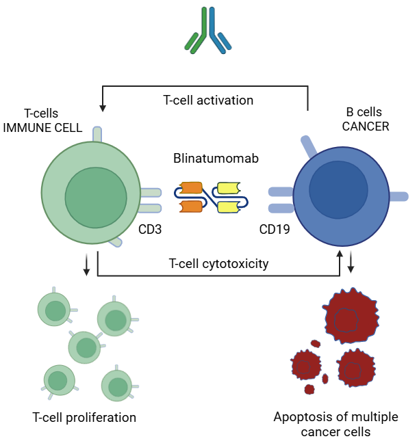
Physiological flow drives BiTE-mediated T cell–tumour engagement, recreating a human-relevant immune microenvironment. To prove the impact of flow on immunotherapy performance within Mera, the BiTE blinatumomab was used as a model system. Blinatumomab is designed to simultaneously bind CD3 on T cells and CD19 on B cells, effectively bridging cytotoxic T lymphocytes with malignant B cells and triggering targeted cell killing,7 as shown in Figure 2. This mechanism is inherently dependent on efficient cell–cell interaction and dynamic immune engagement, making it highly sensitive to microenvironmental conditions. As such, it provides an ideal framework for assessing the influence of flow on immune-mediated cytotoxicity.
Conclusion and future outlook
This study demonstrates that incorporating physiological flow into in vitro models significantly enhances T-cell-mediated cytotoxicity and activation. By replicating key aspects of the human immune microenvironment, the Mera platform provides a more predictive treatment response.
The potential for early detection of cytokine-driven toxicities such as CRS further strengthens the value of this approach. Future work will focus on incorporating patient-derived samples into the Mera platform to further enhance its translational relevance. By integrating autologous or donor-matched immune and tumour cells, the system has the potential to enable personalised assessment of cytokine release profiles in response to therapy. Monitoring key cytokines such as TNF-α, IFN-γ and IL-2 – already demonstrated in this study – could provide early insights into T-cell activation and potential CRS risk.
As the field continues to move towards more human-centric methodologies, the adoption of flow-based NAMs is likely to play an increasingly important role in improving translational success. Looking ahead, integrating such platforms into drug discovery pipelines could help bridge the long-standing gap between preclinical research and clinical outcomes, ultimately accelerating the development of more effective immunotherapies.
To learn more about how flow-based models are advancing immunotherapy research and to explore additional application notes from Hooke Bio, visit: https://hookebio.com/application-notes/
References
1. Cox MC, Mendes R, Silva F, et al. (2021), Application of LDH assay for therapeutic efficacy evaluation of ex vivo tumor models, Scientifiic Reports (11), 18571.
2. Alberts B, Johnson A, Lewis J, et al. Molecular Biology of the Cell. 4th edition. New York: Garland Science; 2002. Helper T Cells and Lymphocyte Activation. Available from: https://www.ncbi.nlm.nih.gov/books/NBK26827/
3. Wu Y. (2026), Revitalizing T cells: breakthroughs and challenges in overcoming T cell exhaustion. Signal Transduction and Targeted Therapy, (11) 2.
4. Morris EC, Neelapu SS, Giavridis T, Sadelain M. (2021), Cytokine release syndrome and associated neurotoxicity in cancer immunotherapy, Nature Reviews Immunology, (22) 2, 85-96. doi: 10.1038/s41577-021-00547-6
5. Wang X, Kopec AK, Collinge M, et al. (2023), Application of Immunocompetent Microphysiological Systems in Drug Development: Current Perspective and Recommendation. ALTEX, 40(2). doi:10.14573/altex.2205311
6. Liang X, Bu X, Yuan S, et al. (2026), Microfluidic engineering of immune-competent organs-on-chips and their applications. Frontiers in Immunology, 17 | https://doi.org/10.3389/fimmu.2026.1743806
7. Mocquot P, Mossazadeh Y, Lapierre L, et al. (2022). The pharmacology of blinatumomab: state of the art on pharmacodynamics, pharmacokinetics, adverse drug reactions and evaluation in clinical trials. Journal of Clinical Pharmacy and Therapeutics, (47), 1337-1351.














No comments yet