



Could organ-chips catch drug failures before they reach clinical trials? As regulatory interest in human-relevant models grows, researchers still need evidence that they are predictive, reproducible and practical enough to guide real development decisions.
Predicting how a potential drug will behave in humans remains one of the biggest challenges in preclinical development. Conventional cell cultures cannot reproduce many features of human physiology, while findings from animal models do not always translate into patients.
New Approach Methodologies (NAMs) are giving researchers more options. Organ-on-a-chip systems, advanced in vitro models and computational approaches are designed to provide human-relevant information before a candidate reaches clinical trials.
Regulatory interest is also increasing. Initiatives in the US and UK are encouraging greater use of human-relevant approaches and the generation of evidence needed to support their wider adoption.
Greater regulatory support, however, does not mean these models are ready for routine use. Researchers still need evidence that they are predictive, reproducible and practical enough to guide decisions during drug discovery.
Jim Corbett, CEO and member of the Board of Directors at Emulate, discusses where organ-on-a-chip technology can add value, what is holding back wider adoption and why the future of preclinical testing is unlikely to depend on any single model.
Why human relevance matters
Interest in NAMs is growing as researchers seek more reliable ways to predict human efficacy and toxicity before compounds reach clinical trials.
For Corbett, regulatory and funding initiatives are accelerating that change.
“The biggest driver has been an unprecedented level of alignment among regulators and funding agencies around the need for more human-relevant science,” he said.
This has implications for when researchers begin considering these technologies. Rather than treating human-relevant models as an additional experiment late in preclinical development, Corbett argues that they should be considered earlier, where they may help inform which compounds progress.
The biggest driver has been an unprecedented level of alignment among regulators and funding agencies around the need for more human-relevant science.
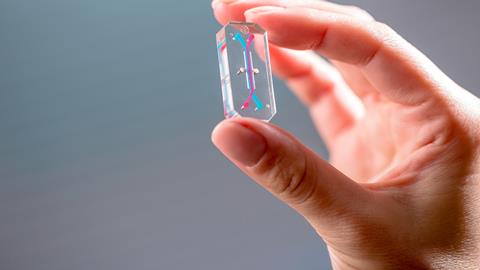
Organ-on-a-chip technology is one approach. These systems use living human cells in engineered environments designed to reproduce specific aspects of tissue physiology.
Unlike static cell culture, organ-chips can recreate features such as tissue-tissue interfaces and vascular flow. Compounds can be introduced through a vascular channel, allowing researchers to examine how a drug interacts with adjacent tissue and monitor the resulting response.
“Human-relevant models allow researchers to study drug responses using living human cells in environments that more closely replicate the structure, function and exposure conditions of the human body,” Corbett explained.
The aim is not to recreate an entire human organ in the laboratory. Instead, researchers can model particular features of human physiology that are relevant to the question they need to answer.
Finding toxicity before the clinic
Safety assessment is one area where Corbett sees an immediate application.
Drug-induced liver injury (DILI) remains an important cause of drug attrition. Identifying compounds with the potential to cause liver toxicity before clinical testing could prevent unsuitable candidates from progressing further through development.
Human-relevant models allow researchers to study drug responses using living human cells in environments that more closely replicate the structure, function and exposure conditions of the human body.
A 2022 study published in Communications Medicine evaluated Emulate’s Liver-Chip for predicting DILI. The model achieved 87 percent sensitivity and 100 percent specificity when data from two donors were combined across a subset of 18 drugs.
“Our Liver-Chip, for example, has demonstrated stronger predictive performance for drug-induced liver injury, one of the leading causes of drug attrition during development, than conventional animal models or hepatic spheroids,” Corbett said.
Identifying safety liabilities before a compound reaches clinical trials could help researchers decide which candidates to progress and which require further investigation.
Our Liver-Chip, for example, has demonstrated stronger predictive performance for drug-induced liver injury, one of the leading causes of drug attrition during development, than conventional animal models or hepatic spheroids.
But predictive performance in one application does not mean a model can answer every preclinical question.
“No single model can answer every biological question,” Corbett said.
Organ-chips therefore need to be considered alongside other experimental and computational approaches, with the choice of model determined by the biological question being asked.
Reproducibility remains critical
Scientific relevance alone will not drive widespread adoption.
One of the main challenges facing organ-on-a-chip technology has been scalability. Early systems could reproduce aspects of human biology but often required substantial manual effort, limiting their compatibility with the throughput expected in pharmaceutical research.
Reproducibility is another important consideration.
“Researchers need confidence that results can be replicated across laboratories and that variability is driven by biology rather than differences in how experiments are performed,” Corbett explained.
Distinguishing biological effects from technical variation is essential if these models are to guide decisions about which compounds to progress. For technology developers, this means reducing experimental variability, increasing automation and demonstrating that performance can be reproduced between laboratories.
Researchers need confidence that results can be replicated across laboratories and that variability is driven by biology rather than differences in how experiments are performed.
Regulatory qualification provides another way to build confidence in these technologies. Emulate’s Liver-Chip S1 has been accepted into the US Food and Drug Administration’s Innovative Science and Technology Approaches for New Drugs (ISTAND) Program, which provides a pathway for novel drug development tools to undergo regulatory qualification.
“Ultimately, broad adoption depends on delivering systems that are scientifically robust, operationally practical and capable of fitting seamlessly into existing drug discovery workflows,” Corbett said.
Where AI could add value
Organ-chip experiments can generate complex imaging and multimodal datasets, creating opportunities for AI to support their analysis.
“AI can improve image analysis by identifying subtle signs of toxicity earlier, assess whether cells have been seeded consistently before an experiment begins, and help improve quality control and reproducibility,” Corbett said.
AI could also support model development by predicting which experimental conditions are most likely to succeed, reducing the amount of trial and error required.
Longer term, Corbett sees potential for digital twin approaches to extend what researchers learn from organ-chips. This could be particularly useful for chronic diseases, where running biological experiments over extended periods can be difficult.
Starting with the biological question
For organisations considering NAMs, Corbett recommends resisting the temptation to replace an entire preclinical workflow at once.
“Start with a clearly defined question that existing models struggle to answer,” he said.
That might be a toxicity that existing approaches predict poorly, a mechanism that depends on human-specific physiology or a translational question that has proved difficult to investigate using conventional models.
Researchers can then assess whether a human-relevant model provides information that changes how they interpret a compound or decide what happens next.
“Rather than attempting to replace an entire preclinical workflow overnight, identify an area where a human-relevant model can add immediate value, whether that’s understanding toxicity, improving translational relevance, or evaluating a specific biological mechanism,” Corbett explained.
Different models have different strengths and limitations. The choice of NAM should therefore depend on the scientific question and whether it can provide information that existing approaches cannot.
Rather than attempting to replace an entire preclinical workflow overnight, identify an area where a human-relevant model can add immediate value.
Where organ-chips could go next
Safety assessment is likely to remain an important application, but organ-on-a-chip technology is moving into other areas of drug discovery.
One area is neuroscience, where modelling the blood-brain barrier (BBB) remains difficult. Corbett points to Emulate’s Brain-Chip, which is designed to model BBB biology and allow researchers to investigate whether compounds reach, or are excluded from, the brain.
This could be useful both for therapies intended to enter the central nervous system (CNS) and for compounds where brain exposure may create unwanted effects.
Further development will also depend on practical improvements. Higher throughput, greater automation and stronger reproducibility will be necessary if organ-chips are to move from specialised experiments towards routine use in pharmaceutical R&D.
Corbett expects animal testing to become less common in some areas as human-relevant methods become better validated and regulators gain confidence in the resulting data. But he does not see the future as a simple replacement of animal models with one alternative technology.
“Ultimately, the future isn’t about replacing one technology with another,” he said. “It’s about building an integrated ecosystem of human-relevant models, computational tools and advanced analytical approaches that together provide a more accurate picture of how therapies will perform in patients.”
For early drug discovery researchers, the more immediate question is where these models can improve a decision today. Demonstrating human relevance is only the starting point. To become routine tools, NAMs will need to show that their results are predictive, reproducible and practical enough to determine which compounds move forward.






No comments yet