Researchers have shown that applying magnetic forces to lab-grown human heart organoids enhances their maturation and vascular development, offering a more realistic model of early heart formation and the possibility of future cardiac therapies.
Heart disease remains the leading cause of death worldwide, yet efforts to better understand and treat cardiac disorders are constrained by the limitations of existing experimental models. Animal models frequently fail to reflect human-specific cardiac biology, while conventional two-dimensional cell cultures lack the structural and functional complexity of real human heart tissue. These challenges have caused a growing interest in regenerative medicine approaches that can more accurately reproduce human heart development and disease.
Among the most promising of these approaches are stem cell–derived cardiac organoids. These three-dimensional, self-organising tissues recapitulate key aspects of early heart development and provide new opportunities to study congenital heart defects, drug-induced cardiotoxicity and personalised therapeutic responses.
The challenge of immaturity in cardiac organoids
Despite their potential, most cardiac organoids remain developmentally immature and poorly vascularised, limiting their usefulness for translational research. A major reason for this shortcoming is the absence of mechanical forces that are essential for heart development in the human body. In vivo, the developing heart is constantly shaped by physical cues such as contraction, pressure and shear stress, but these forces are rarely reproduced in organoid systems.
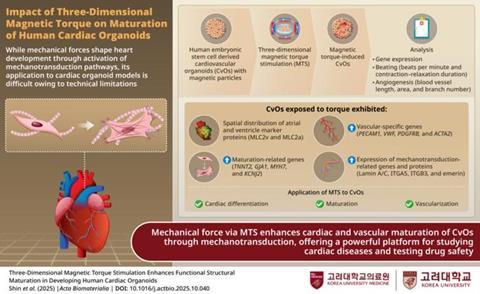
To address this challenge, a team of researchers led by Professor Yongdoo Park from the Department of Biomedical Sciences at Korea University, explored whether mechanical stimulation could enhance organoid development. Their study investigated the application of magnetic torque stimulation (MTS) to three-dimensional cardiac organoids to mimic the mechanical forces present during early heart formation.
Applying magnetic torque to mimic heart development
The researchers used an in vitro experimental approach to examine how mechanical cues influence cardiac organoid maturation. Human embryonic stem cells were first differentiated into three-dimensional cardiac organoids. These organoids were then incorporated with surface-bound magnetic particles, allowing them to respond to externally applied magnetic fields.
The researchers used an in vitro experimental approach to examine how mechanical cues influence cardiac organoid maturation.
Using a custom system, the team applied controlled magnetic torque during a defined early developmental window. This stimulation was designed to replicate aspects of physiological cardiac mechanics. The effects on organoid maturation and vascularisation were assessed using a comprehensive set of molecular, structural and functional analyses. These included gene and protein expression profiling, immunofluorescence imaging, measurements of beating behaviour and calcium transients and transcriptomic analysis.
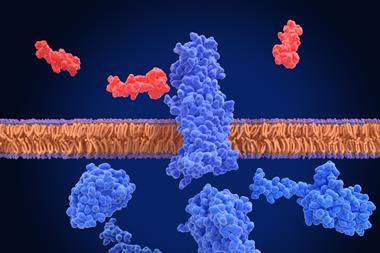
 Magnetic torque activates mechanotransduction pathways promoting functional and vascular maturation of cardiac organoids. Credit: Professor Yongdoo Park from Korea University, Republic of Korea.[/caption]
 Enhanced maturation through mechanical stimulation
The results demonstrated that magnetic torque had a marked impact on cardiac development. Organoids exposed to mechanical stimulation showed improved differentiation, more advanced maturation and enhanced vascular features compared with unstimulated controls.
The results demonstrated that magnetic torque had a marked impact on cardiac development.
“Torque-stimulated activated mechanotransduction pathways, with accompanying improvements in cardiac differentiation, maturation and vascularisation,” said Professor Park.
These findings suggest that recreating mechanical cues is a crucial step towards producing more physiologically relevant cardiac organoids.
Implications for drug testing and personalised medicine
Mechanically matured cardiac organoids could offer a powerful new platform for drug safety testing, providing more accurate, human-relevant models for cardiotoxicity screening and reducing reliance on animal studies. As vascular features are incorporated, these organoids may also become more dependable and reproducible across laboratories.
Mechanically matured cardiac organoids could offer a powerful new platform for drug safety testing, providing more accurate, human-relevant models for cardiotoxicity screening and reducing reliance on animal studies.
Looking ahead, torque-stimulated cardiac organoids could support patient-specific disease modelling and personalised treatment strategies. They also offer a valuable system for studying how mechanical, molecular and cellular signals interact during early human heart development.
“Our study opens new avenues for studying cardiac development, disease mechanisms and therapeutic responses in systems that more closely reflect human physiology,” concludes Professor Park. “In addition, the platform provides a reliable and reproducible model that can also be extended to other organoid systems in which mechanical cues play a key regulatory role. By reducing dependence on animal models, such platforms can accelerate drug discovery and testing, contributing to safer and more personalised treatment decisions.”


Topics
- 3D Cell Cultures
- Biotechnology & Bioengineering
- Cardiovascular disease
- Disease Research
- Drug Development
- Drug Discovery
- Drug Discovery Processes
- Drug Targets
- In Vitro Testing
- Microscopy
- Molecular Biology
- Neurological disorders
- Organoids
- Personalised Medicine
- Precision Medicine
- Professor Yongdoo Park (the Department of Biomedical Sciences at Korea University)
- Regenerative Medicine
- Regenerative Medicine dupe
- Stem Cells
- the Department of Biomedical Sciences at Korea University
- Translational Science