At ELRIG’s Drug Discovery 2025, Drug Target Review spoke with the teams turning big ideas into usable tools – automation, AI and biology – that help scientists work smarter.
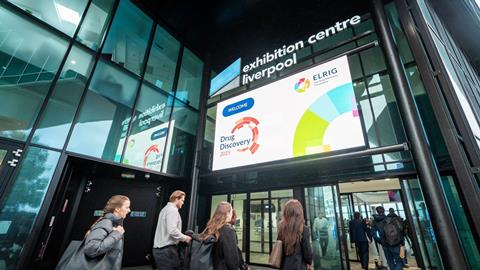
ELRIG’s Drug Discovery 2025 in Liverpool made one thing clear: drug discovery is entering a more practical phase. The focus has shifted from big claims to tangible progress – automation that saves time, data systems that connect and biology that better reflects human complexity.
Drug Target Review attended the conference to speak directly with the companies driving these changes, including Eppendorf, Tecan, SPT Labtech, Sonrai Analytics, Cenevo, mo:re and Nuclera, to name a few. Across two days of interviews and discussions, one message came through clearly: scientists want technology that integrates easily, delivers reliable data and saves time.
The event’s atmosphere was focused and collaborative. Exhibitors spoke about reproducibility, integration and usability, displaying technologies that can fit into existing workflows – not force workflows to adapt around them.
Tools built for scientists
For Eppendorf, automation starts with ergonomics. Paul Withers, Automation Product and Application Manager, described the company’s new Research 3 neo pipette as “an operator’s pipette”, built following extensive surveys of working scientists.
The model combines features from two previous designs, introducing a lighter frame, a shorter travel distance and a larger plunger to distribute pressure. A one-handed control lets users switch easily between fast and fine volume adjustment, reducing strain over long periods.
Small usability touches matter. The addition of colour-coded silicone bands replaces the tape and pen labels common in busy labs. “It sounds simple, but it keeps equipment clean and organised,” Withers noted.
The broader goal is to make automation accessible. “This is the third wave,” he said. “We want to empower scientists to use automation confidently and save time for analysis and thinking, not just pipetting.”
That principle extends into Eppendorf’s wider automation portfolio, where modularity and flexibility are key. From benchtop instruments to integrated systems, the company aims to create tools that grow with a lab’s needs rather than replace them outright. Withers noted that this mindset, building for usability first, is what turns good engineering into daily lab value.
Automation that adds clarity
Tecan is applying the same philosophy at scale. Senior Advisor Application Solutions and Innovation Lead Mike Bimson described the sector as “branching in two directions”: simple, accessible benchtop systems on one side and large, unattended multi-robot workflows on the other.
Tecan’s Veya liquid handler represents the first path, offering quick, walk-up automation that any researcher can use. At the other end, their FlowPilot software schedules complex workflows where liquid handlers, robots and instruments operate seamlessly.
If AI is to mean anything, we need to capture more than results. Every condition and state must be recorded, so models have quality data to learn from.
Both share a single aim: consistency. “Robustness is everything,” Bimson said. “Replacing human variation with a stable system gives you data you can trust years later.”
He expects a stronger industry focus on metadata and traceability. “If AI is to mean anything, we need to capture more than results. Every condition and state must be recorded, so models have quality data to learn from.”
He also acknowledged that automation is not the answer to everything. “There are still tasks best done by hand. If you only run an experiment once every few years, it is probably not worth automating it,” he said. “Our job is to help customers find that balance – when automation adds real value and when it does not.”
The human element remains central. “Automation is the easy bit,” Bimson added. “Thinking is the hard bit. The point is to free people to think.”
Collaboration as design
At SPT Labtech, collaboration was the defining message. Its firefly+ platform combines pipetting, dispensing, mixing and thermocycling within a single compact unit designed to simplify complex genomic workflows.

SPT Labtech’s firefly+ platform displayed at ELRIG's Drug Discovery 2025, showcasing collaborative automation to simplify complex genomic workflows.[/caption]
In October 2025, the company announced a collaboration with Agilent Technologies to introduce automated target enrichment protocols for genomic sequencing on the firefly+ platform. Developed jointly by SPT Labtech’s applications team and Agilent’s R&D group, the protocols automate Agilent’s SureSelect Max DNA Library Prep Kits for hands-off library preparation.
By combining Agilent’s proven chemistry with firefly+ automation, the workflow enhances reproducibility, reduces manual error and supports high-throughput sequencing in areas such as oncology and precision medicine. The collaboration highlights a wider shift in laboratory automation towards openness and interoperability, enabling users to integrate validated chemistries and adapt rapidly to changing research needs.

One of many engaging posters at ELRIG's Drug Discovery 2025, this poster from The Institute of Cancer Research explores the feasibility of glove recycling in research laboratories, highlighting sustainability efforts within the scientific community.[/caption]
Data that can be trusted
At Cenevo, the conversation was about turning AI from an experiment into a practical lab tool. CEO Keith Hale and Chief Product Officer Jonathan Gross explained that while artificial intelligence is gaining momentum across research, most organisations are still grappling with fragmented, siloed data and inconsistent metadata – barriers that prevent automation and AI from delivering real value.
Cenevo unites two established names under one banner: Titian, known for its Mosaic sample-management software, and Labguru, a digital R&D platform founded by Gross. The new brand reflects a broader goal – helping laboratories connect their data, instruments and processes so that AI can be applied to meaningful, well-structured information.
Gross noted that many labs are “experimenting with, not yet executing” AI because the underlying data landscape remains uneven. The team’s approach is to help organisations first map the location of data, identify where it is locked in and plan automation around that reality. Their AI Assistant feature, already embedded in Labguru and now being extended to Mosaic, supports everyday use cases such as smarter search, experiment comparison and workflow generation – practical steps that cut duplication and save time.
Hale described two complementary directions for progress: “inside-out” – embedding intelligent tools directly into software that scientists already use – and “outside-in” – enabling customers to surface data cleanly into their own corporate data lakes and AI models. Both aim to reduce friction between systems, enabling insight to flow more freely from the bench to enterprise level.
The company’s technology is used by many of the world’s leading pharmaceutical firms, and Hale acknowledged that even these large organisations often have “lots of data, but not much insight yet. Corporate data may not yet help lab operators directly but once AI taps into those data lakes, real insights should emerge.” This, he said, is where the industry now stands: at the early, formative stage of real digital transformation.
Transparent AI in practice
Sonrai shared a similar view. Chief Commercial Officer Chris Brooks and Director of Strategic Solutions Dr Hamzah Syed emphasised transparency as central to building confidence in AI. Dr Syed explained that Sonrai’s workflows are completely open, using trusted and tested tools so clients can verify exactly what goes in and what comes out within its trusted research environment.
The company’s Discovery platform is designed to help pharma and biotech teams integrate complex imaging, multi-omic and clinical data into a single analytical framework. Unlike typical data management platforms, Sonrai integrates advanced AI pipelines and visual analytics to generate directly interpretable biological insights from multi-modal datasets. By layering these datasets, researchers can uncover links between molecular features and disease mechanisms more quickly.
Brooks noted that Sonrai’s approach supports organisations at different stages of digital maturity – from biotech startups generating clinical trial data to global pharma integrating multi-site studies. Close collaboration is key: “Success depends on involving everyone from bioinformaticians to clinicians,” he said. “When each group understands how the data are used, collaboration improves and decisions come faster.”
Sonrai is now applying foundation models to extract features from imaging data, using large-scale AI models trained on thousands of histopathology and multiplex imaging slides to identify new biomarkers and link them to clinical outcomes. The goal, they said, is not only to accelerate discovery but also to make AI-driven decisions explainable and reproducible – essential for building trust with partners and regulators alike.
Automation grounded in biology
mo:re refocused attention back to biological relevance. The company’s fully automated MO:BOT platform standardises 3D cell culture to improve reproducibility and reduce the need for animal models.
Founder and CEO Lukas Gaats said the technology was built from a “biology-first” perspective. The MO:BOT automates seeding, media exchange and quality control, rejecting sub-standard organoids before screening. The system scales easily from six-well to 96-well formats, providing up to twelve times more data on the same footprint.
By producing consistent, human-derived tissue models, mo:re helps developers gain clearer, more predictive safety and efficacy data. “If you can present verified, human-relevant results to regulators, you build confidence and shorten timelines,” Gaats explained. He expects automation to drive the adoption of these new approach methodologies across the industry.
Automating protein expression from design to data
For Nuclera, automation is streamlining how scientists approach protein production. Senior Field Application Scientist Kundan Sharma explained that the company’s eProtein Discovery System unites design, expression and purification in one connected workflow, helping researchers tackle even the most challenging proteins.

Nuclera presenting its eProtein Discovery System at ELRIG's Drug Discovery 2025, an automated platform streamlining protein design, expression and purification for faster, more reliable results.[/caption]
The instrument enables users to move from DNA to purified, soluble and active protein in under 48 hours – a process that can traditionally take weeks. “It helps customers handle the challenging proteins,” Sharma said. “Instead of spending days troubleshooting expression problems, they can focus straight on downstream work.”
Using a cartridge-based format, researchers can screen and optimise up to 192 construct and condition combinations in parallel, ensuring consistent, high-throughput expression. By integrating screening, characterisation and analysis in a single automated run, the system frees scientists from repetitive setup tasks and lets them focus on data interpretation and decision-making.
Nuclera’s system is designed for continuous, 24/7 operation and supports a wide range of protein types including membrane proteins and kinases. Its cloud-based software manages experimental design and results analysis, giving users full visibility across the workflow.
For many delegates at Drug Discovery 2025, Nuclera’s approach captured the practical side of automation: faster, standardised protein production that removes bottlenecks and gives scientists more time to focus on insight and innovation.
The takeaway
Drug Discovery 2025 provided a clear picture of where drug discovery technology is heading. The next gains will come not from larger instruments or louder claims but from systems that combine precision, transparency and usability.
Key themes across the event included:
- Design for people – ergonomic, approachable tools encourage adoption
- Connect everything – integration across hardware and data platforms enables real insight
- Ensure traceability – transparent workflows build trust in AI and analytics
- Follow the biology – automation should support, not dictate, experimental design.
In Liverpool, the conversation was no longer about automation replacing scientists. It was about giving them the tools, time and data quality to do better science. That, more than anything, defined the spirit of Drug Discovery 2025.




Topics
- Analytical Techniques
- Artificial Intelligence & Computational Tools
- Artificial Intelligence (AI)
- Assays
- Bioinformatics
- Cell & Gene Therapy
- Companies
- Drug Discovery
- Drug Discovery Processes
- ELRIG
- Genomics & Sequencing
- High-Throughput Screening (HTS)
- Informatics
- Lab Tools & Automation
- Machine Learning (ML)
- Molecular Biology
- Organoids
- Protein Expression
- Robotics
- Sequencing
- Stem Cells
- Translational Science