Researchers have developed vascularised human retinal organoids featuring the first fully functional light-signal pathways in lab-grown human retina models, opening new possibilities for studying eye disease and testing therapies.
Maintaining retinal ganglion cells deep within lab-grown retinal organoids has been a huge challenge for scientists. These cells, which are critical for transmitting visual information from the eye to the brain, often die in densely packed organoid tissues due to limited nutrient and oxygen supply.
Now, a new study, by an international team led by Professor Volker Busskamp at the University Hospital Bonn (UKB), in collaboration with the University of Bonn and the Institute of Molecular and Clinical Ophthalmology Basel, has developed a method to overcome this. By combining human stem cell-derived retinal organoids with endothelial cells, the researchers created artificial vessels that deliver essential nutrients and oxygen, significantly improving ganglion cell survival.
Vascularised organoids boost ganglion cell survival
In the human eye, axons of retinal ganglion cells form the optic nerve, relaying visual signals to the brain. Reproducing this complex system in vitro has been extremely difficult. The team experimented with several approaches for integrating vascular cells into the organoids and discovered that pre-cultured endothelial cells incorporated most effectively into already formed organoid spheres.
In the human eye, axons of retinal ganglion cells form the optic nerve, relaying visual signals to the brain.
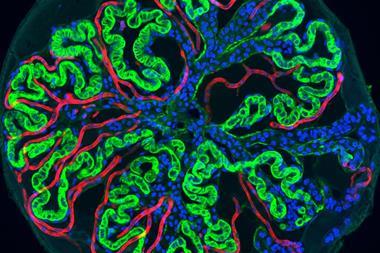
The researchers reported that the approach preserves the developmental processes whilst increasing the number of surviving ganglion cells. Analyses confirmed that other retinal cell types developed normally in these vascularised retinal organoids (vROs), while ganglion cells survived longer and achieved higher functional maturity.
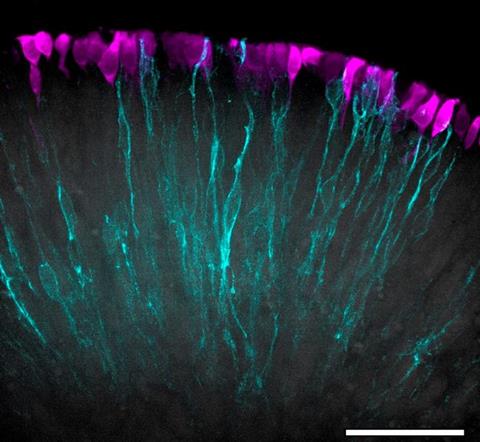
 These vascularised vROs exhibit improved function of optic nerve cells and, for the first time, form fully functional light-signalling pathways from the photoreceptors to the retinal ganglion cells. Credit: University Hospital Bonn.[/caption]
 Enhanced functionality demonstrated in the lab
To evaluate retinal ganglion cell activity, the team used microelectrodes and microfluidic devices that support stable axon growth. In the vascularised organoids, ganglion cells fired more frequently, synchronously, and with higher intensity compared to non-vascularised organoids. Optogenetic techniques enabled precise light stimulation, producing markedly stronger and more reliable responses.
In the vascularised organoids, ganglion cells fired more frequently, synchronously, and with higher intensity compared to non-vascularised organoids.
After several weeks, the vROs developed functional light-signal pathways: photoreceptors reacted to light, and signals were correctly transmitted to the ganglion cells, displaying typical ON, OFF and ON-OFF response patterns.
“Incorporation of vascular cells dramatically improves ganglion cell survival and function, enabling the first comprehensive in vitro demonstration of vertical signal transmission from photoreceptors to ganglion cells. This advance establishes retinal organoids as a functional in vitro platform for studying human retinal development and disease,” explains Professor Busskamp, corresponding author of the study and head of the degenerative retinal diseases research group at UKB.
New opportunities for disease modelling and drug testing
Beyond improving cell survival, the vascularised organoids also responded to hypoxia. Under low-oxygen conditions, the artificial vessels formed new networks, mimicking changes observed in certain retinal diseases. This feature could allow researchers to model conditions such as retinopathy of prematurity and test potential therapies in a controlled lab environment.
The method is straightforward and adaptable to other organoid systems. By producing retinal organoids with functional ganglion cells and complete light-signal pathways, this advance offers sophisticated human retinal models for studying disease, screening drugs and exploring future treatment strategies.
With vascularised retinal organoids, researchers now have a more realistic in vitro system to investigate how the human retina develops and reacts to stress, potentially accelerating discoveries in vision science and ophthalmic medicine.



Topics
- 3D Cell Cultures
- Assays
- Cell & Gene Therapy
- Disease Research
- Drug Development
- Drug Discovery Processes
- Eye Diseases
- High-Throughput Screening (HTS)
- Imaging & Diagnostics
- In Vitro Testing
- Molecular Biology
- Neurological disorders
- Neurons
- Organoids
- Professor Busskamp (head of the degenerative retinal diseases research group at UKB)
- Regenerative Medicine
- Stem Cells
- the Institute of Molecular and Clinical Ophthalmology Basel
- the University Hospital Bonn (UKB)
- the University of Bonn
- Translational Science