





Childhood myopia researcher Dr Klaus Trier explores how 7-methylxanthine targets scleral remodelling and axial elongation, and its potential to slow disease progression and reduce the risk of high myopia.
Childhood myopia (short-sightedness) has become one of the fastest growing chronic diseases worldwide. As the prevalence of high myopia (severe short-sightedness) continues to rise, research is exploring approaches that address the biological mechanisms driving axial elongation.
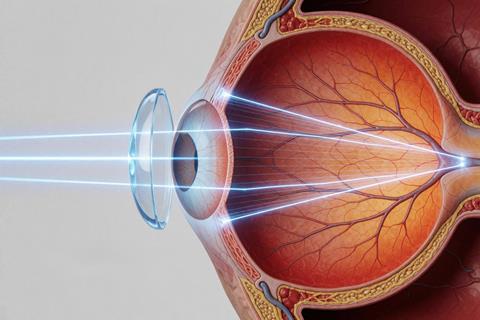
Myopia is a progressive eye condition in which the eyeball becomes too long or the cornea too curved, causing the light to focus in front of the retina. While genetics can contribute, the dramatic rise in global myopia is largely driven by environmental factors, particularly reduced time outdoors and exposure to sunlight, as well as increased screen use.
Childhood myopia (short-sightedness) has become one of the fastest growing chronic diseases worldwide.
Recognised as the leading cause of preventable blindness, the condition is estimated to affect nearly 50 percent of the global population, with approximately 1 billion people expected to develop myopia greater than -5.00 diopters by 2050.1
Every diopter of myopia that develops in childhood is accompanied by axial elongation of the eyeball. This stretching – and not the refractive error itself –drives the sight-threatening complications associated with the condition in later life, such as retinal detachment, myopic maculopathy, glaucoma and cataract.2 The risk rises steeply once myopia passes -6.00 diopters,2 hence the primary clinical goal is not simply to correct blur, but to slow the rate at which children’s eyes elongate.
If untreated during childhood, elongation of the eye typically continues until around age 16, when natural collagen cross-linking in the sclera stabilises eye structure,3 at which point intervention becomes far less effective. Early onset, especially before age 10, is strongly associated with progression to high myopia and risk of visual impairment.4,5 Once myopia has developed, it cannot be reversed. Early intervention is therefore critical to protect long-term ocular health.
Optical approaches such as orthokeratology and multifocal lenses, as well as pharmacological approaches such as low-dose atropine eye drops have become the standard for myopia control. However, each comes with practical limitations: variable efficacy, the need for specialist fitting or daily drops – and in some cases side effects such as distorted vision, inflammation, light sensitivity as well as rebound effects once treatment stops.6- 9 There remains a clear need for additional, well-tolerated options, especially those that improve administration and adherence in children.
A unique approach targeting the back of the eye
7-methylxanthine (7-MX) is a naturally occurring metabolite of caffeine and theobromine that has been investigated as a therapeutic oral option for more than twenty years.
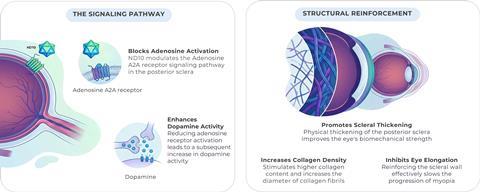
7-MX is an adenosine 2A (A2A) receptor inhibitor that indirectly enhances dopamine activity, which in turn promotes structural reinforcement in the sclera at the back of the eye.10,11 Adenosine and dopamine receptors are co-localised in the retina and retinal epithelium, forming a functional unit so that blocking of the adenosine receptor facilitates transmission at the dopamine receptor. The dopamine acts as a crucial biochemical ‘stop signal’ for eye growth to reduce axial elongation.12
Collagen production is also stimulated, where collagen fibrils are strengthened and thickened in the posterior sclera to resist ocular elongation and slow the progression of myopia.10,11 Preclinical studies in infant macaques, rabbits and guinea pigs have demonstrated that 7-MX increased collagen concentration and fibril diameter, preventing scleral thinning and elongation.11-14 Toxicology studies in rodents support a favourable safety profile.15-17
Owing to its multiple mechanisms involving neurotransmitter modulation and tissue remodelling, 7-MX shows promise as a drug treatment for high myopia prevention, especially during active eye development.
Clinical trials and real-world evidence
The Danish Medicines Agency cleared a trial to evaluate an oral immediate-release formulation of 7-MX, now called ND10, in a 36-month placebo-controlled pilot study in 68 myopic children with a mean age of 11.3 years.18 Axial growth was reduced in children treated continuously with 7-MX at three-year follow-up, with no adverse effects reported – consistent with its low-toxicity profile. Long-term use demonstrated cumulative benefits with no rebound effect after discontinuation.
The statistically significant data from the trial led to pharmacy-compounded 7-MX immediate release formulation tablets licensed for use in Denmark in 2009. 7-MX has since been continuously used in real-world clinical practice in Denmark for more than two decades in over 1,200 children, with some treated over many years. This extended real-world use has generated valuable longitudinal data on treatment patterns, safety and progression outcomes. Importantly, there have been no reports of safety concerns at any of the dosages tested and treatment compliance has remained high.
A retrospective analysis of longitudinal data from 711 Danish children with myopia found that treatment with 7-MX was associated with slower myopia progression, with an effect proportional to the dosage.19 Modelling based on this data estimated that treatment could reduce myopia progression by 0.70 diopters over three years, corresponding to a 48percent reduction for an 11-year-old child at baseline.19
Viewed alongside evidence from other clinical trials, 7-MX treatment results in a consistently slower rate of myopia progression over time. These findings suggest its potential to complement existing myopia control strategies and may be particularly useful when monotherapy with low-dose atropine or optical interventions does not sufficiently slow progression.
Impact on the development of high myopia
Retrospective analyses have also explored long-term outcomes, including the incidence of high myopia defined as more than -6.00 diopters.
To understand whether slowing myopia progression translates to reduced risk of high myopia, a long-term retrospective observational study evaluated Danish children treated continuously with 7-MX from age 10 through 17.20 Among 46 children with less than -3.00 diopters of myopia at age 10 (average daily dose of around 700mg), the prevalence of high myopia at age 17 was six times lower than in a comparable cohort of untreated Dutch children.
Among the 65 myopic children with less than -6.00 diopters of myopia at age 10 treated continuously with 7-MX until age 17, only nine developed high myopia, compared with 20.3 cases predicted using progression rates reported in the untreated cohort in the Dutch DREAM study.4
Although observational, these findings suggest that sustained slowing of myopia progression may translate into clinically meaningful reduction in the development of high myopia.
Clinical Implications and future directions
As childhood myopia continues to rise globally, there remains a need for well-tolerated therapies that complement existing optical and pharmacologic interventions. An oral therapy with an emerging clinical and real-world evidence base could expand the treatment options available to clinicians, particularly for children whose disease continues to progress despite current management strategies.
As childhood myopia continues to rise globally, there remains a need for well-tolerated therapies that complement existing optical and pharmacologic interventions.
In 2024 the US National Academies of Sciences, Engineering and Medicine formally recognised myopia as a disease, reflecting a growing understanding of myopia’s long-term health consequences and the urgency of early intervention. Continued prospective, controlled research will be important to confirm these real-world findings and to establish 7-MX’s place alongside current treatment options.
Although the existing clinical and real-world data are encouraging, much of the evidence to date has been generated in Denmark. Multinational studies will be important to determine reproducibility across broader patient populations.
A sustained release formulation has been developed with the goal of maintaining more consistent plasma concentrations while reducing dosing frequency. Its potential clinical impact will be evaluated in a global Phase III trial.
The rapid global rise in childhood myopia has highlighted the need for therapies that target the biological mechanisms driving disease progression, especially for children who are most vulnerable. The growing body of mechanistic, clinical and real-world evidence highlights the broader therapeutic potential of targeting connective tissue and scleral remodelling. Whether used alone or alongside existing optical and pharmacological interventions, this strategy represents an important direction as the field moves towards disease-modifying treatments for myopia.
References
- Holden BA, Fricke TR, Wilson DA, et al. Global Prevalence of Myopia and High Myopia and Temporal Trends from 2000 through 2050. Ophthalmology. 2016;123(5):1036-1042. doi:10.1016/j.ophtha.2016.01.006
- Saw SM, Gazzard G, Shih-Yen EC, Chua WH. Myopia and associated pathological complications. Ophthalmic Physiol Opt. 2005;25(5):381-391. doi:10.1111/j.1475-1313.2005.00298.x
- Bailey AJ, Paul RG, Knott L. Mechanisms of maturation and ageing of collagen. Mech Ageing Dev. 1998;106(1-2):1-56. doi:10.1016/s0047-6374(98)00119-5
- Polling JR, Klaver C, Tideman JW. Myopia progression from wearing first glasses to adult age: the DREAM Study. Br J Ophthalmol. 2022;106(6):820-824. doi:10.1136/bjophthalmol-2020-316234
- Saluja G, Kaur K. Childhood Myopia and Ocular Development. In: StatPearls. Treasure Island (FL): StatPearls Publishing; May 4, 2023
- Cho P, Cheung SW. Retardation of myopia in Orthokeratology (ROMIO) study: a 2-year randomized Alinical trial. Investigative ophthalmology & visual science. 2012 Oct 1;53(11):7077-85.
- Bullimore MA, Johnson LA. Overnight orthokeratology. Contact lens and anterior eye. 2020 Aug 1;43(4):322-32.
- Walline JJ, Walker MK, Mutti DO, et al. Effect of high add power, medium add power, or single-vision contact lenses on myopia progression in children: the BLINK randomized clinical trial. Jama. 2020 Aug11;324(6):571-80.
- Lam CS, Tang WC, Lee PH, et al. Myopia control effect of defocus incorporated multiple segments (DIMS)spectacle lens in Chinese children: results of a 3-year follow-up study. British Journal of Ophthalmology. 2022 Aug 1;106(8):1110-4.
- Fan Y, Li J, Huang L, et al. 7-Methylxanthine Influences the Behavior of ADORA2A-DRD2 Heterodimers in Human Retinal Pigment Epithelial Cells. Ophthalmic Res. 2022;65(6):678-684. doi:10.1159/000525563
- Cui D, Trier K, Zeng J, et al. Effects of 7-methylxanthine on the sclera in form deprivation myopia in guinea pigs. Acta Ophthalmol. 2011 Jun;89(4):328-34. doi: 10.1111/j.1755-3768.2009.01688.x. Epub 2009 Oct 23. PMID: 19860777
- Hung LF, Arumugam B, Ostrin L, et al. The Adenosine Receptor Antagonist, 7-Methylxanthine, Alters Emmetropizing Responses in Infant Macaques. Invest Ophthalmol Vis Sci. 2018;59(1):472-486. doi:10.1167/iovs.17-22337
- Trier K, Olsen EB, Kobayashi T, Ribel-Madsen SM. Biochemical and ultrastructural changes in rabbit sclera after treatment with 7-methylxanthine, theobromine, acetazolamide, or L-ornithine. Br J Ophthalmol. 1999;83(12):1370-1375. doi:10.1136/bjo.83.12.1370
- Nie HH, Huo LJ, Yang X, et al. Effects of 7-methylxanthine on form-deprivation myopia in pigmented rabbits. Int J Ophthalmol. 2012;5(2):133-137. doi:10.3980/j.issn.2222-3959.2012.02.03
- Singh H, Sahajpal NS, Singh H, et al. Pre-clinical and cellular toxicity evaluation of 7-methylxanthine: an investigational drug for the treatment of myopia. Drug and chemical toxicology. 2021 Nov 2;44(6):575-84.
- Singh H, Singh H, Sahajpal NS, et al. Sub-chronic and chronic toxicity evaluation of 7-methylxanthine: a new molecule for the treatment of myopia. Drug and Chemical Toxicology. 2022 May 4;45(3):1383-94.
- Singh H, Singh H, Sharma S, et al. Genotoxic and mutagenic potential of 7-methylxanthine: an investigational drug molecule for the treatment of myopia. Drug and Chemical Toxicology. 2024 May 3;47(3):264-73.
- Trier K, Munk Ribel-Madsen S, Cui D, Brøgger Christensen S. Systemic 7-methylxanthine in retarding axial eye growth and myopia progression: a 36-month pilot study. J Ocul Biol Dis Infor. 2008 Dec;1(2-4):85-93. doi: 10.1007/s12177-008-9013-3
- Trier K, Cui D, Ribel-Madsen S, Guggenheim J. Oral administration of caffeine metabolite 7-methylxanthine is associated with slowed myopia progression in Danish children. Br J Ophthalmol. 2023 Oct;107(10):1538-1544. doi: 10.1136/bjo-2021-320920.
- Trier K. Treatment with adenosine antagonist 7-methylxanthine (7-MX) from age 10 reduces the risk of high myopia at age 17. ARVO Annual Meeting Abstract. Invest Ophthalmol Vis Sci. 2025;66(8):2814.

















No comments yet