



Human biospecimens can bring drug discovery closer to human disease, but their value depends on far more than the sample itself. We explore the factors that determine how much researchers can learn from them.
Human biospecimens provide researchers with direct access to human biology and can play an important role across drug discovery.
Blood, plasma, serum, tissue and primary cells can be used to investigate disease mechanisms, validate potential drug targets, identify biomarkers and explore differences between patient populations. They can also help researchers assess whether findings from experimental models reflect what happens in human disease.
However, using human material does not automatically make an experiment more relevant. The value of a biospecimen depends not only on what type of sample it is, but also on the biological and technical context surrounding it.
What happens to a specimen before it reaches the laboratory can affect the material researchers eventually analyse. Its origin, collection, processing, preservation and storage all matter, as does the information available about the specimen and donor.
For example, a tumour sample accompanied by information about disease subtype, stage and previous treatment can provide far greater context than one described only by tissue type.
Understanding the history and characteristics of a biospecimen is therefore important for ensuring the resulting data can reliably inform drug discovery decisions.
The journey behind every biospecimen
Human biospecimens include a wide range of biological materials, including solid tissues, whole blood, plasma, serum, peripheral blood mononuclear cells (PBMCs), bone marrow and other patient-derived samples.
Different specimens provide access to different aspects of disease biology. For example, tumour tissue can allow researchers to examine molecular changes directly within the disease environment, while blood-derived specimens can provide information about circulating biomarkers, immune responses and systemic changes associated with disease.
Preservation also affects how specimens can be used. Fresh, frozen and formalin-fixed paraffin-embedded (FFPE) tissues have different properties and may be suited to different analytical approaches.
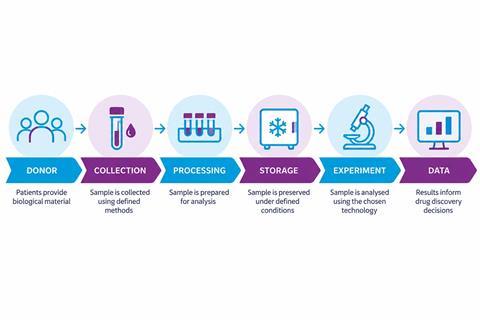
Each biospecimen passes through several stages before it becomes experimental data, as shown in the image below. Understanding what happens along this journey can help researchers interpret the final results.
Start with the biology
Before selecting a specimen, it is important to establish what biological question it needs to answer.
Human disease is heterogeneous, so samples from patients with the same diagnosis may not represent the same underlying biology.
This is particularly important for target validation. If a potential target is highly expressed in one patient group, the characteristics of that group need to be considered when assessing how broadly the finding applies.
Previous treatment can also be important. Therapeutic intervention may alter signalling pathways, gene expression, immune responses or the cellular composition of tissue. Samples collected before and after treatment may therefore represent different biological states.
Controls also require careful consideration. Healthy tissue may provide a useful comparison with diseased tissue, but the control material still needs to be appropriate for the biological question and sufficiently comparable with the disease samples.
Selecting human specimens should therefore begin with the hypothesis rather than with the material that happens to be available.
Choose the specimen according to the biology you need to investigate. Availability alone does not make a sample suitable for a study.
What happened before the sample reached the laboratory?
Experimental variation can begin before an assay starts. The time between collection and processing, temperature, preservation method, storage conditions and freeze-thaw history can all affect a sample.
The impact of these pre-analytical variables depends on what is being measured. DNA, RNA, proteins, metabolites and viable cells have different requirements, meaning a specimen suitable for genomic analysis may not be suitable for transcriptomics or a functional cell assay.
This is particularly relevant when comparing specimens from different sites or collections. Differences in collection, processing or storage can introduce technical variation that may be difficult to distinguish from genuine biological differences.
Standardised procedures can help reduce this variation. Where this is not possible, a clear record of sample handling can help researchers account for relevant differences during analysis.
The value of metadata
A biospecimen is more useful when information about its biological and technical context is available. Depending on the study, this may include diagnosis, disease subtype, stage, previous treatment and donor characteristics, as well as collection, processing and storage details.
For example, two tumour specimens from patients with the same cancer may represent different biological states. One may come from a treatment-naïve patient with early-stage disease, while the other may come from a patient with advanced disease following several lines of treatment.
Metadata can help identify these differences and group samples appropriately. This is particularly important when investigating a therapeutic target that may only be relevant to a specific patient population.
Identifying a specimen simply as tumour tissue therefore provides limited information about the biology it represents.
A tissue type alone tells only part of the story. Patient, disease and sample history provide the context needed to interpret the data.
When sample quality becomes experimental noise
Sample quality is not a single measure. What makes a biospecimen suitable depends on the biological material being analysed and the experiment it needs to support.
For example, DNA integrity and quantity may determine whether a sample is suitable for genomic analysis, while transcriptomic studies depend on RNA integrity and preservation. Functional assays have different requirements again, as cells need to remain viable and retain the phenotype being investigated.
Poor or inconsistent sample quality can introduce variation that is unrelated to the biology under study. If samples within a cohort differ substantially in degradation, viability or preservation, these differences can affect the resulting measurements and make genuine biological signals harder to identify.
This can also affect reproducibility. Two laboratories may follow the same analytical protocol but obtain different results if the specimens entering the experiment differ in quality or handling history.
Quality criteria should therefore be defined before samples are selected or analysed, based on the intended endpoint. Researchers can then assess whether specimens meet the requirements of the experiment, identify samples that may introduce unwanted variation and avoid using limited material for analyses it cannot reliably support.
Matching the sample to the technology
Different analytical technologies place different demands on human biospecimens. Genomic studies require sufficient DNA of appropriate quality and quantity, transcriptomic approaches depend on RNA preservation and proteomic studies require consideration of protein stability and sample processing.
Spatial analysis requires sufficiently preserved tissue architecture to investigate the location of cells, proteins or transcripts, while functional experiments may require viable cells that retain the phenotype being studied.
| Experimental approach | Key sample considerations |
| Genomics | DNA quality and quantity |
| Transcriptomics | RNA preservation and integrity |
| Proteomics | Protein stability and processing |
| Spatial analysis | Tissue architecture and preservation |
| Functional assays | Cell viability and phenotype |
The analytical method should therefore be considered when samples are selected or allocated. Quantity also matters, as using limited material for an initial experiment may leave too little for validation or further analysis.
Planning sample use in advance can help ensure the material is suitable for both the immediate experiment and any subsequent work.
Building the right sample cohort
Sample suitability extends beyond individual specimens. The cohort also needs to represent the disease biology being investigated.
Patients with the same diagnosis may differ in molecular subtype, disease stage, genetics and treatment history. This can affect drug discovery conclusions. For example, if target expression is concentrated within a particular subtype, combining all samples into one disease group could mask that signal or make it difficult to identify which patients it applies to.
Cohort design should therefore reflect the hypothesis. Exploratory studies may require samples that capture broader disease variation, while target-validation studies may focus on a particular molecular feature or patient subgroup.
Sample number should also be considered alongside composition. A larger cohort is not necessarily more informative if relevant patient groups are poorly represented or important differences between them are not accounted for.
Controls should also match the research question and may include healthy donors, unaffected tissue, different disease subtypes or samples without the molecular feature being investigated.
Understanding where a specimen came from
The provenance of a human biospecimen is another important consideration.
Researchers need to know where material came from, how it was collected and whether it can be used for the intended research. Informed consent, donor privacy and the handling of associated information are particularly relevant when specimens are linked to clinical, demographic or genomic data.
Requirements can vary depending on the specimen, where and how it was collected, the associated information and its intended use.
Clear documentation and traceability can help establish whether a specimen is appropriate for the proposed research. Relevant records may include how and when the sample was collected and processed, the consent obtained, permitted research uses and any restrictions on associated donor data.
Getting more from human biospecimens
Human biospecimens can provide evidence that is difficult to obtain from experimental models alone. They can support target validation, biomarker discovery and the investigation of differences between patient populations using material derived directly from humans.
Their value, however, depends on more than access to the sample. Donor characteristics, disease context, collection, processing, storage, metadata and analytical requirements all affect what can be learned from it.
There is therefore no single best type of human biospecimen. The appropriate sample is one that represents the biology being investigated, provides sufficient context to interpret the results and meets the requirements of the planned experiment.
Considering these factors from the outset can help researchers generate more reliable and relevant evidence to inform drug discovery decisions








No comments yet