


Artificial intelligence (AI) virtual cells could help researchers predict biological responses before laboratory testing, but how reliable are their predictions? This Discovery Toolkit compares computational and experimental cell models, their limitations and the evidence needed to guide drug discovery decisions.
AI virtual cells could change how researchers investigate cellular responses, using biological data to predict how cells might react to genetic changes, drug treatments and other interventions before laboratory testing.
But how reliable are these predictions? Recent studies examining genetic perturbations have reached different conclusions about whether AI models outperform simpler computational methods.¹,² Questions also remain about how accurately virtual cells can predict drug responses and perform in unfamiliar biological conditions.
Unlike computational predictions, experimental models allow researchers to observe and measure cellular responses directly. Cell cultures, organoids and other laboratory systems can provide evidence of how cells respond to interventions, although their ability to reproduce human disease varies.
So, how do virtual cells compare with experimental models, and what evidence is needed before researchers can trust their predictions?
Two ways to investigate cellular responses
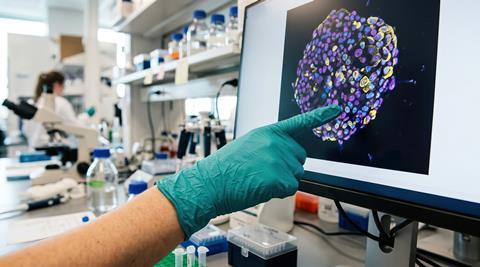
Experimental models use living cells or tissues to investigate biological activity. Researchers can introduce genetic changes, expose cells to compounds and measure outcomes such as viability, protein expression or signalling activity. These experiments range from conventional two-dimensional cell cultures to organoids and more complex tissue models.
Rather than measuring these responses directly, AI virtual cells use computational models to predict them. Depending on the model, they may draw on single-cell transcriptomics, proteomics, imaging and genetic perturbation data to estimate how cells respond to different interventions.
However, not all virtual cells have the same capabilities. Many current models focus on predicting changes in gene expression following genetic perturbations, rather than capturing the full range of cellular behaviour.
Researchers are also working towards virtual cells that can simulate more complex biological processes. A 2024 paper published in Cell described the goal of developing AI virtual cells capable of modelling biological processes across molecular, cellular and tissue scales.³ Achieving this remains a major research challenge.
Virtual cells vs experimental cell models
| Decision factor | AI virtual cells | Experimental cell models |
|---|---|---|
| Starting point | Existing biological data | Living cells or tissues |
| Main output | Predicted cellular responses | Measured biological responses |
| Typical applications | Perturbation prediction and experiment prioritisation | Target validation, compound screening and mechanistic studies |
| Main advantage | Can evaluate proposed interventions computationally | Measures responses directly in biological systems |
| Main limitation | Predictions depend on data coverage and generalisation | Results depend on model relevance and experimental conditions |
| Biological complexity | Limited by available data and model capabilities | Varies from simple cultures to complex tissue models |
| Validation | Independent benchmarking and experimental confirmation | Controls, reproducibility and biological relevance |
| Practical role | Prioritising hypotheses for testing | Establishing whether predicted effects occur |
Decision point one: what question are you trying to answer?
The choice between virtual cells and experimental models depends on what researchers need to find out.
For example, a team investigating resistance to a cancer treatment might want to identify genes that influence how tumour cells respond to the drug. A virtual cell model could predict which genetic changes might affect treatment resistance, helping researchers identify genes for further investigation. Researchers could then test these predictions in laboratory models by disrupting the selected genes and measuring whether the cells become more or less sensitive to treatment.
In this example, the virtual cell would help researchers decide which genes to investigate, while experimental testing would establish whether altering those genes affects treatment response.
This use of virtual cells to guide experimental testing is also discussed in a 2026 review in Trends in Pharmacological Sciences. The authors identify the prioritisation of compounds and follow-up experiments as potential applications, while emphasising the need to validate whether these models improve experimental decisions.⁴
Toolkit takeaway: Virtual cells can help researchers identify genes for further investigation, while laboratory experiments can establish whether changes to those genes affect treatment response.
Decision point two: does the model represent the right biology?
Cell type, genetic background and disease state can all affect how cells respond to treatment. For example, a compound that alters a signalling pathway in an established cancer cell line may produce a different response in patient-derived tumour cells.
Researchers therefore need experimental models that reflect the disease being investigated. Patient-derived organoids can retain features of tissue architecture and cellular heterogeneity, making them useful for studying disease mechanisms and drug responses.⁵ However, conventional organoids may lack components of the immune system or surrounding tissues, and their reproducibility can vary.
Similar limitations apply to virtual cells. A model trained on data from one cell type or experimental condition may not accurately predict responses in another.⁶ Researchers should therefore examine the training data and whether the model has been tested in cell types and disease conditions relevant to their study.
Decision point three: can virtual cells predict unseen perturbations?
Predicting responses to previously untested interventions remains a challenge for virtual cells. Models may perform well on familiar data but struggle with new genetic perturbations or biological conditions.
In 2025, Ahlmann-Eltze and colleagues compared seven deep-learning models with simpler methods for predicting gene expression changes following genetic perturbations. None outperformed the simpler methods on the tasks evaluated.¹ A subsequent Nature Methods study benchmarked 27 computational methods across 29 datasets and identified limitations in their ability to predict responses in unfamiliar cellular contexts. The authors also identified cellular-context embeddings as a potential way to improve generalisation.⁶
However, an October 2026 Nature Biotechnology study found that some commonly used performance metrics were poorly calibrated. Using better-calibrated metrics, its authors reported that deep-learning models could outperform uninformative baselines, such as predicting the average response across all perturbations.²
These studies used different benchmarks and metrics, so their results cannot be compared directly. Better-calibrated metrics may change how models rank against baselines, but whether deep-learning models consistently outperform simpler methods on unseen perturbations is still being debated.
Before relying on predictions for an untested intervention, researchers should check how the model performs against appropriate baselines, whether it has been shown to generalise to unseen conditions, and whether its predicted responses have been validated experimentally.
Toolkit takeaway: Do not judge a virtual cell by its reported accuracy alone. Examine the benchmark, evaluation metrics and performance against simpler methods, particularly for perturbations not included during training.
Decision point four: what evidence is needed before progressing a hit?
A virtual cell might predict that a compound could reduce the activity of a signalling pathway associated with tumour growth. However, a predicted response is not enough to establish whether the compound is a suitable hit for further development.
Researchers would need to test the compound in disease-relevant cell models, measuring pathway activity, target engagement and effects on cell viability. They would also need to establish whether the response is concentration-dependent, reproducible and consistent with the proposed mechanism.
A reduction in tumour cell viability, for example, does not necessarily indicate that the compound is acting through its intended target. Additional experiments are needed to distinguish target-specific activity from nonspecific toxicity or assay interference.
A 2026 review in the British Journal of Pharmacology discusses applications of virtual cells in target prioritisation, drug response prediction and combination therapy design, while examining the challenges of developing reliable predictive models.⁷
Toolkit takeaway: A predicted hit is a hypothesis, not a result. Before progressing it, confirm its activity in disease-relevant models, demonstrate that it engages the intended target, and test whether the effect is reproducible, selective and not explained by nonspecific toxicity.
Decision point five: when should virtual and experimental models be combined?
Virtual cells and experimental models can be used together throughout early drug discovery. Computational predictions can help researchers decide which targets, compounds or biological responses to investigate, while laboratory experiments provide evidence to assess those predictions.
Experimental results can also provide new data for training or updating virtual cell models, allowing researchers to reassess predictions and select subsequent experiments. However, incorporating additional data does not automatically improve predictive accuracy.
The value of combining these methods depends on whether they improve research decisions. Researchers should assess whether computational prioritisation increases the number of experimentally validated hits, reduces the number of experiments required or identifies candidates that existing methods would have missed.
Toolkit takeaway: Use virtual cells to inform experimental priorities and laboratory results to evaluate predictions. Assess whether combining the two improves decisions compared with experimental methods alone.
Choosing the right cellular modelling strategy
Virtual cells and experimental models have different strengths and limitations. Virtual cells can help prioritise targets, compounds and experiments, while laboratory models provide the biological evidence needed to assess those predictions. Both depend on the quality and relevance of the data they produce.
Combining computational predictions with experimental testing could make early drug discovery more efficient, particularly when researchers need to narrow down large numbers of potential targets or compounds. However, the benefit must be demonstrated through reliable predictions, reproducible experimental results and better decisions about which candidates to progress.
References
-
Ahlmann-Eltze C, Huber W, Anders S. Deep-learning-based gene perturbation effect prediction does not yet outperform simple linear baselines. Nat Methods. 2025;22(8):1657–1661. doi:10.1038/s41592-025-02772-6.
-
Miller HE, Mejia GM, Leblanc FJA, et al. Deep learning perturbation models can outperform baselines on calibrated metrics. Nat Biotechnol. 2026. doi:10.1038/s41587-026-03307-w.
-
Bunne C, Roohani Y, Rosen Y, et al. How to build the virtual cell with artificial intelligence: priorities and opportunities. Cell. 2024;187(25):7045–7063. doi:10.1016/j.cell.2024.11.015.
-
Wang S, Zhang Y, Wang D, Liu H, Yao X. AI virtual cells for drug discovery and pharmacology. Trends Pharmacol Sci. 2026;47(10):1085–1098. doi:10.1016/j.tips.2026.08.006.
-
Wang D, Villenave R, Stokar-Regenscheit N, et al. Human organoids as 3D in vitro platforms for drug discovery: opportunities and challenges. Nat Rev Drug Discov. 2026;25:204–226. doi:10.1038/s41573-025-01317-y.
-
Wei Z, Wang Y, et al. Benchmarking algorithms for generalizable single-cell perturbation response prediction. Nat Methods. 2026;23:451–464. doi:10.1038/s41592-025-02980-0.
-
Jia Y, Xing X, Han H, et al. Virtual cell construction for artificial intelligence-driven drug discovery. Br J Pharmacol. 2026. doi:10.1111/bph.70585.








No comments yet