



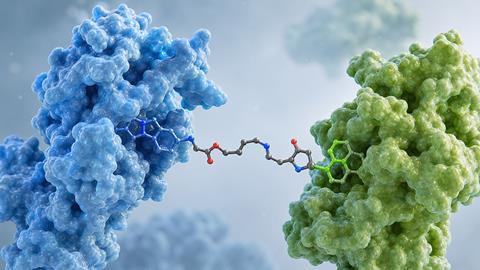
PROTACs and molecular glues can both remove disease-associated proteins, but choosing between them is far from simple. In our first Discovery Toolkit, we compare their strengths, limitations and the key questions discovery teams should ask before selecting a strategy.
Targeted protein degradation has changed what it means to drug a protein.
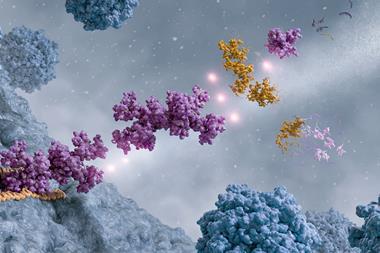
Rather than continuously binding to and inhibiting a protein, targeted protein degradation aims to remove it from the cell altogether. It does this by directing disease-associated proteins towards the cell’s own protein degradation machinery.
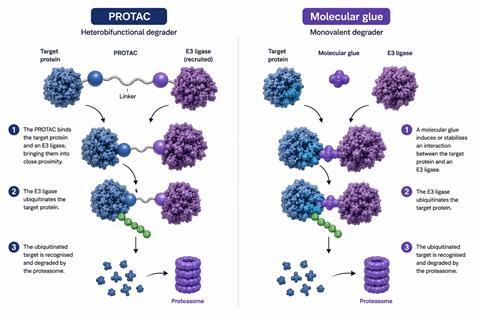
Two strategies have become particularly important: proteolysis-targeting chimeras (PROTACs) and molecular glue degraders. Both recruit E3 ubiquitin ligases to promote ubiquitination and subsequent degradation of a target protein by the proteasome, but they achieve this in different ways.
Those differences have important consequences for drug discovery. PROTACs and molecular glues require different starting chemistry, screening strategies and optimisation, and present their own challenges around selectivity and developability.
For discovery teams, the question is therefore not which strategy is better, but which is best suited to the target, its biology and the requirements of the programme.
Two routes to the same destination
PROTACs are heterobifunctional molecules containing a ligand that binds a protein of interest and another that recruits an E3 ubiquitin ligase, connected by a linker. Bringing the two proteins together can form a ternary complex, enabling ubiquitination of the target and its subsequent degradation by the proteasome.
Molecular glue degraders take a different route. These are typically monovalent small molecules that induce or stabilise an interaction between an E3 ligase and a new substrate. Rather than physically tethering two independently binding ligands, the compound alters molecular recognition so that the ligase recruits a protein it would not normally target.
These different mechanisms require different discovery strategies.
A PROTAC programme can often begin with known ligands for the target and E3 ligase, providing defined starting points for design and optimisation. Molecular glue discovery is less modular and has historically relied more heavily on serendipitous discovery. Advances in library design, screening and chemical biology are now enabling more systematic discovery.¹
| Decision factor | PROTACs | Molecular glue degraders |
| Architecture | Heterobifunctional, with a target-binding ligand, linker and E3 ligase recruiter | Typically monovalent and linker-free |
| Typical starting point | Known ligands for the protein of interest and an E3 ligase | Chemical matter with potential to induce or stabilise a productive E3-target interaction |
| Discovery strategy | Design-led, with multiple components that can be systematically optimised | Screening-led, with systematic and target-focused methods advancing |
| Molecular size | Typically larger and often beyond conventional rule-of-five space | Generally smaller and closer to conventional small-molecule chemical space |
| Key optimisation considerations | Target engagement, E3 recruitment, linker design, ternary-complex formation and cellular exposure | Productive E3-target interactions, cooperativity, selectivity and identification of suitable chemical matter |
| Permeability | Can be challenging because of molecular size and physicochemical properties | Smaller size can reduce some permeability constraints associated with PROTACs, although this remains compound dependent |
| Target requirements | Usually requires a ligand capable of binding the protein of interest | Can induce or stabilise interactions without requiring a conventional high-affinity ligand for the target |
| Useful discovery capabilities | Medicinal chemistry, structural and biophysical methods, and cellular degradation assays | Screening, proteomics, structural biology, genetics and mechanistic deconvolution |
| Major discovery hurdle | Achieving potent and selective degradation alongside suitable exposure and drug-like properties | Predictably discovering a productive glue for a predefined target |
Decision point one: do you already have a target ligand?
For many programmes, one of the first questions is whether a suitable ligand for the target already exists.
PROTACs usually need a ligand that can bind the protein of interest. If researchers already have one and it can be chemically linked to an E3 ligase recruiter without losing target binding, they have a useful starting point for PROTAC design.
Importantly, the ligand does not need to be a highly effective inhibitor. Its role is to help bring the target protein and E3 ligase together so that a productive ternary complex can form, leading to ubiquitination and degradation of the target.
From there, researchers can test different linkers, attachment points and E3 ligase recruiters to determine which combinations produce the most effective degradation.
This gives PROTAC discovery a relatively modular design process, but success is far from guaranteed. Effective degradation depends on more than target binding alone. The interactions between the target and E3 ligase within the ternary complex also matter, as does whether formation of that complex leads to efficient ubiquitination.²
Molecular glues present a different discovery challenge. Rather than physically linking a target-binding ligand to an E3 ligase recruiter, a molecular glue induces or stabilises an interaction between the target and an E3 ligase.
This means molecular glues do not necessarily require the type of high-affinity target ligand typically sought in conventional small-molecule drug discovery. That creates opportunities to investigate proteins that have been difficult to address through conventional inhibition.
The challenge is finding the right glue. Historically, molecular glue degraders were often discovered serendipitously, but systematic screening and mechanism-based design strategies are making their discovery more deliberate. Despite this progress, extending these strategies to a wider range of predefined targets remains a challenge.³
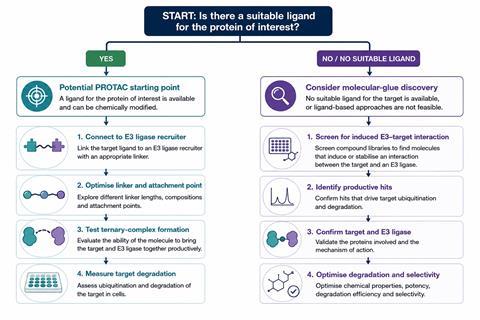
Toolkit takeaway: If a suitable target ligand already exists, a PROTAC may provide the more direct starting point. If conventional ligand discovery has struggled, molecular glue discovery could provide another route, but will generally demand different screening and mechanistic capabilities.
Decision point two: what does your chemistry need to achieve?
PROTAC optimisation requires several parts of the molecule to work together. The target-binding ligand, E3 ligase recruiter, linker and attachment points can each influence how effectively the target is degraded.
A major challenge is molecular size. PROTACs often fall outside Lipinski’s rule of five, a set of guidelines describing properties commonly associated with orally active small-molecule drugs. Their larger size and physicochemical complexity can make it more difficult to achieve good membrane permeability, solubility and pharmacokinetic properties.
These challenges do not rule out successful drug development. In May 2026, vepdegestrant became the first heterobifunctional protein degrader to receive FDA approval.⁴ As an orally administered PROTAC, its development demonstrates that compounds in this class can achieve oral exposure despite their physicochemical complexity.⁵
Developability therefore needs to be considered alongside degradation from an early stage. A compound that degrades its target effectively in vitro will still need sufficient cellular exposure and suitable pharmacokinetic properties to become a viable drug candidate.
Molecular glues present a different set of challenges. They are generally smaller and do not require the linker used in PROTACs, which can give them more conventional small-molecule properties.
Their optimisation instead depends on the protein-protein interaction they induce or stabilise. Small structural changes can affect which proteins are recruited, the cooperativity of the interaction and which proteins are ultimately degraded.
Toolkit takeaway: If molecular size and conventional small-molecule properties are critical programme constraints, molecular glues may offer advantages. PROTAC programmes provide greater modularity, but teams need to address permeability and developability alongside degradation from the outset.
Decision point three: which E3 ligase should you recruit?
The E3 ligase recruited by a degrader can have a major effect on whether degradation is successful.
Despite the large number of E3 ubiquitin ligases in the human proteome, PROTAC development has so far relied heavily on a small number, with cereblon (CRBN) and von Hippel-Lindau (VHL) dominating the field.⁶ One reason is the availability of suitable chemical matter. Well-characterised small-molecule ligands already exist for CRBN and VHL, making these E3 ligases accessible and extensively validated starting points for PROTAC design.
E3 ligases differ in their expression and activity across tissues and cell types. A ligase that produces effective degradation in one cell type may therefore be less suitable in another.
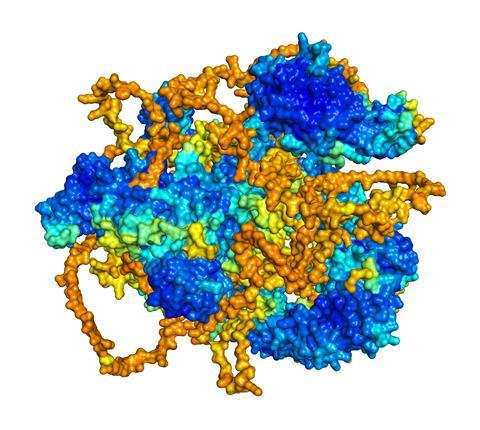
Researchers need to consider whether the E3 ligase is expressed and active in the disease-relevant cells, whether a suitable recruiter is available and whether bringing it together with the target results in efficient ubiquitination and degradation.
Molecular glue discovery can present a different challenge. When a glue is identified through phenotypic screening, the E3 ligase responsible for its activity may not initially be known. Genetic screening, quantitative proteomics and structural studies can then help identify the ligase, target and mechanism involved.
Decision point four: how will you know degradation is working?
Measuring a reduction in the target protein is an important first step, but it does not establish how or why degradation is occurring.
Two common measurements are DC50, the concentration that produces half-maximal degradation, and Dmax, the maximum level of degradation achieved. Together, they help describe how potently and extensively a compound degrades its target.⁷
Researchers also need to confirm that degradation occurs through the intended mechanism. Depending on the programme, this can include measuring target engagement, ternary-complex formation, ubiquitination and dependence on the recruited E3 ligase and proteasome.
Degradation kinetics also matter. How quickly the target is depleted, how long protein levels remain suppressed and how rapidly the protein is resynthesised can all affect the biological response.
Selectivity should also be assessed beyond the intended target. Productive ternary-complex formation can give degraders selectivity that is not apparent from target binding alone. However, unintended proteins may also be recruited and degraded.
Quantitative proteomics can help identify these effects by measuring changes in protein abundance across the proteome, rather than monitoring the intended target alone.
Toolkit takeaway: Do not optimise solely against DC50. Combine degradation measurements with mechanistic assays, kinetics and proteome-wide selectivity wherever possible.
Decision point five: what can your discovery platform actually support?
The two strategies place different demands on a discovery team.
PROTAC programmes typically require iterative medicinal chemistry to test combinations of target ligands, E3 ligase recruiters, linkers and attachment points. Biochemical, biophysical and cellular assays can then help determine how these changes affect ternary-complex formation and target degradation.
Molecular glue discovery often presents a different starting challenge. Researchers need to find compounds that induce or stabilise a productive interaction between an E3 ligase and target protein.
Historically, phenotypic screening followed by target identification and mechanistic studies has played an important role in molecular glue discovery. More systematic strategies now combine approaches such as targeted screening, chemical proteomics, genetic screening and structural biology to identify and characterise productive interactions.
Despite these advances, discovering a molecular glue for a predefined target remains less predictable than assembling a PROTAC from known binding ligands.
The practical question is therefore whether a team has the methods needed for the discovery route it chooses. PROTAC programmes may place greater emphasis on iterative degrader chemistry and ternary-complex optimisation, while molecular glue programmes can require extensive screening, target identification and mechanistic characterisation.
How can resistance affect targeted degradation?
Resistance can also develop against targeted protein degraders.
Changes to the target protein, E3 ligase or other components of the ubiquitin-proteasome system can interfere with degradation. For example, loss or alteration of the recruited E3 ligase can prevent a degrader from forming the interactions needed to remove its target.
This is particularly relevant because current targeted protein degradation strategies rely on a relatively small number of E3 ligases. Developing recruiters for a wider range of ligases could provide alternative routes to degradation and allow researchers to select ligases that are better suited to particular tissues or disease settings.
For discovery teams, understanding these potential resistance mechanisms early could help inform E3 ligase selection and degrader design before a candidate progresses.
Five questions to ask before choosing a degrader
1. Why should this protein be degraded?
Degradation should solve a biological problem that inhibition does not. Removing scaffolding functions, eliminating multiple activities of the same protein or achieving prolonged pharmacology may provide such a rationale.
2. What chemical starting point do you have?
A characterised target ligand can make a PROTAC programme easier to initiate. Without one, the discovery problem changes considerably.
3. Which E3 ligase makes sense in the relevant biology?
Do not consider recruiter availability alone. Expression, localisation and activity in the disease-relevant cell or tissue matter.
4. How will you demonstrate mechanism and selectivity?
Plan for more than a protein-level readout. Mechanistic assays, kinetics and proteomics can prevent apparently promising degradation from masking an unsuitable mechanism.
5. What properties will the eventual medicine require?
Permeability, route of administration, tissue exposure, pharmacokinetics and safety need to influence modality selection early, not after a lead series has already been established.
Choosing the right degradation strategy
PROTACs and molecular glues aim to achieve the same outcome, but present different challenges for discovery teams.
PROTACs offer a more modular route to degradation when suitable ligands for the target and E3 ligase are already available. Their larger size, however, can create challenges around permeability, cellular exposure and other physicochemical properties.
Molecular glues are generally smaller and can induce protein-protein interactions without requiring a conventional high-affinity target ligand. Their main challenge comes earlier: identifying compounds that can recruit a chosen target to an E3 ligase remains less predictable.
Neither strategy is inherently better. The choice should be guided by the target biology, available chemistry, E3 ligase, experimental capabilities and properties required of the final drug candidate.
References
- Gray JL, Xiao Z, Rogga VV, Zhang X, Tate EW. From serendipity to strategy: rationalizing molecular glue discovery and proximity-induced pharmacology through chemical biology. J Am Chem Soc. 2026;148(5):4791-4814. doi:10.1021/jacs.5c12299.
- Wurz RP, Rui H, Dellamaggiore K, Ghimire-Rijal S, Choi K, Smither K, et al. Affinity and cooperativity modulate ternary complex formation to drive targeted protein degradation. Nat Commun. 2023;14:4177. doi:10.1038/s41467-023-39904-5.
- Liu Y, Bai J, Li D, Cang Y. Routes to molecular glue degrader discovery. Trends Biochem Sci. 2025;50(2):134-142. doi:10.1016/j.tibs.2024.12.006.
- Kumar A, Ali S, Shen Q, Zhou J. FDA approval of the first-ever PROTAC: vepdegestrant (ARV-471) marks a new era in targeted protein degradation. J Med Chem. 2026;69(14):16135-16142. doi:10.1021/acs.jmedchem.6c02076.
- Ma Z, Zhou J. NDA submission of vepdegestrant (ARV-471) to U.S. FDA: the beginning of a new era of PROTAC degraders. J Med Chem. 2025;68(14):14129-14136. doi:10.1021/acs.jmedchem.5c01818.
- Shrestha S, Maitland MER, Jing L, Duan S, Nie DY, St-Germain J, et al. Characterization of PROTAC specificity and endogenous protein interactomes using ProtacID. Nat Commun. 2025;16:8089. doi:10.1038/s41467-025-63357-7.
- Apprato G, D’Agostini G, Rossetti P, Ermondi G, Caron G. In silico tools to extract the drug design information content of degradation data: the case of PROTACs targeting the androgen receptor. Molecules. 2023;28(3):1206. doi:10.3390/molecules28031206.








No comments yet