
Scientists have discovered active bacterial traces inside brain tumours, overturning assumptions about the brain’s sterility and opening up new possibilities for understanding – and potentially treating – gliomas and brain metastases.
Researchers at The University of Texas MD Anderson Cancer Center have identified surprising traces of bacteria within brain tumours, which goes against longstanding assumptions about the brain’s sterility. The findings provide scientists with new information on the complex environment in which brain tumours develop and could potentially help support new approaches to treatment.
The study discovered bacterial genetic material and cellular components within tumour cells and throughout the tumour microenvironment. Crucially, these bacterial elements appeared biologically active, indicating they could play a role in influencing tumour behaviour and disease progression in patients with gliomas and brain metastases.
“This work opens a new dimension in our understanding of brain tumour biology,” said Jennifer Wargo, MD, professor of surgical oncology and genomic medicine and a core member of the James P. Allison Institute™. “By mapping how microbial elements influence the brain tumour microenvironment, we may be able to identify new therapeutic strategies to improve outcomes for patients facing these devastating diseases.”
Why brain tumour microbes matter
Gliomas and brain metastases are among the most challenging cancers to treat and are often fatal. A more detailed understanding of tumour biology is much needed in order to improve treatment responses.
While microbial communities have been documented in cancers such as colorectal tumours, scientists have long questioned if microbes exist universally across all cancer types. This new study – the largest of its kind to investigate bacterial presence in brain tumours – provides the strongest evidence yet that bacterial elements can indeed be found within brain tumour cells.
While microbial communities have been documented in cancers such as colorectal tumours, scientists have long questioned if microbes exist universally across all cancer types.
The discovery is particularly significant because the brain has traditionally been regarded as a sterile environment. Consequently, brain tumours were not believed to contain bacteria in any form.
“These findings highlight a previously unknown player in the brain tumour microenvironment – a new piece of the puzzle that may help explain brain tumour behaviour,” said Dr Golnaz Morad, postdoctoral research fellow in surgical oncology “Bacterial elements appear to interact with immune cells within the tumour in ways that could influence how tumours develop and respond to treatment.”

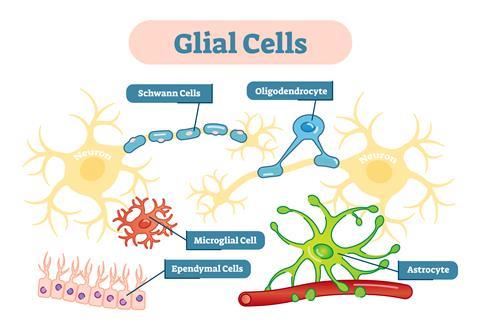
An illustration of the brain’s glial cells – key components of the tumour microenvironment that researchers are now examining more closely after discovering bacterial elements within brain tumours.[/caption]
Key findings from the research
The research team analysed more than 200 brain tissue samples, using an array of advanced techniques including genetic sequencing, bacterial culture and high-resolution imaging.
The research team analysed more than 200 brain tissue samples, using an array of advanced techniques.
In addition to identifying bacterial elements within tumour cells, scientists discovered that these microbial components were linked to distinct tumour characteristics. Specifically, they were associated with activity in antimicrobial and immune-metabolic pathways – which may influence tumour progression.
Bioinformatic analysis also suggested a link between bacteria detected in brain tumours and microbial communities in other parts of the body, particularly the oral microbiome. This raises questions about whether bacteria originating in the mouth may somehow reach the brain in certain patients.
Study limitations
The study is promising, however, as a correlative clinical study, the research cannot yet determine whether bacterial elements directly cause changes in tumour behaviour. Additionally, microbial populations vary significantly depending on geography, environment and lifestyle. Therefore, the bacterial types identified in this study will need to be validated in larger and more diverse patient groups.
Despite these limitations, the findings develop our understanding of how brain tumours form, evolve and respond to treatment – with the potential to influence future therapies and improve outcomes for patients.
Next steps for research
Building on these findings, researchers now aim to determine how bacterial elements enter the brain and what role they may play in tumour growth or treatment response. They will also investigate whether conditions such as gum disease or side effects from chemotherapy and radiotherapy might influence this process.
Ultimately, scientists hope this line of research will be the beginning for a new line of therapeutic strategies based on modifying or targeting tumour-associated bacteria.




Topics
- Analytical Techniques
- Cancer
- Cancer
- Disease Research
- Dr Golnaz Morad (postdoctoral research fellow in surgical oncology)
- Genomics & Sequencing
- High-Throughput Screening (HTS)
- Imaging & Diagnostics
- Jennifer Wargo (professor of surgical oncology and genomic medicine and a core member of the James P. Allison Institute™)
- Microbiology
- Microbiome
- Microscopy
- Molecular Biology
- Neurological disorders
- Neurosciences
- Oncology
- Rare & Genetic Disorders
- The University of Texas MD Anderson Cancer Center
- Translational Science