

Autonomous Scanning Probe Microscopy technique developed using AI
Posted: 20 March 2020 | Victoria Rees (Drug Target Review) | No comments yet
Using AI and deep learning, researchers have enhanced Scanning Probe Microscopy (SPM) and made their automated resource available for scientists.
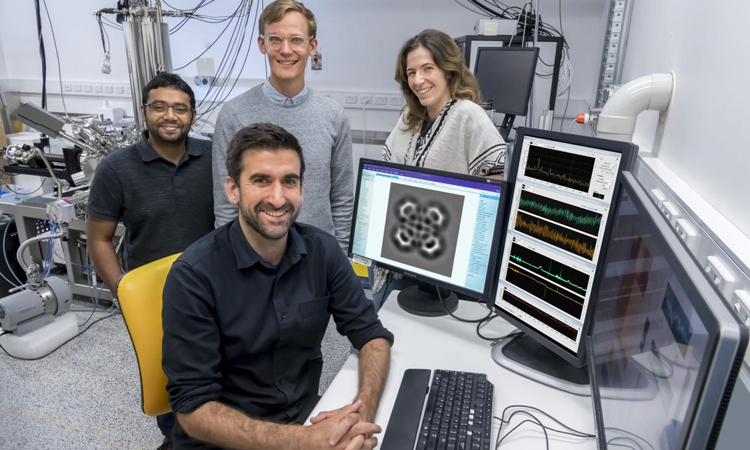
Dr Agustin Schiffrin and his team at the School of Physics and Astronomy (Monash University) [credit: FLEET].
A new collaboration has demonstrated fully-autonomous Scanning Probe Microscopy (SPM) operation, applying artificial intelligence (AI) and deep learning to remove the need for constant human supervision.
According to the researchers, the new system, dubbed DeepSPM, bridges the gap between nanoscience, automation and AI, firmly establishing the use of machine learning for experimental scientific research.
“Optimising SPM data acquisition can be very tedious. This optimisation process is usually performed by the human experimentalist and is rarely reported,” said Future Low-Energy Electronics Technologies (FLEET) Chief Investigator Dr Agustin Schiffrin, at Monash University, Australia. “Our new AI-driven system can operate and acquire optimal SPM data autonomously, for multiple straight days and without any human supervision.”
The advance brings advanced SPM methodologies such as atomically-precise nanofabrication and high-throughput data acquisition closer to a fully automated turnkey application, say the researchers.
The new deep learning approach can also be generalised to other SPM techniques. The researchers have made the entire framework publicly available online as open source, creating an important resource for the nanoscience research community.
“Crucial to the success of DeepSPM is the use of a self-learning agent, as the correct control inputs are not known beforehand,” said Dr Cornelius Krull, project co-leader. “Learning from experience, our agent adapts to changing experimental conditions and finds a strategy to maintain the system stable.”
The AI-driven system begins with an algorithmic search of the best sample regions and proceeds with autonomous data acquisition. It then uses a convolutional neural network to assess the quality of the data. If the quality of the data is poor, DeepSPM uses a reinforcement learning agent to improve the condition of the probe.
The system can run for several days, acquiring and processing data continuously, while managing SPM parameters in response to varying experimental conditions, without any supervision, highlight the researchers.
The study was published in Communications Physics.
Related topics
Analytical Techniques, Artificial Intelligence, Imaging, Informatics, Lab Automation, Microscopy
Related organisations
Future Low-Energy Electronics Technologies (FLEET), Monash University
Related people
Dr Agustin Schiffrin, Dr Cornelius Krull