

Drug discovery could be improved with new collapsible basket technology
Posted: 9 March 2020 | Rachael Harper (Drug Target Review) | No comments yet
A collapsible basket technology has been developed to significantly accelerate the analysis process when scientists are developing new medicines.
Researchers from Purdue University have developed a collapsible basket technology to help speed up the process of retrieving cell and tissue samples for histology analysis during high-throughput screening. This, they say, will significantly accelerate the analysis process when drug discovery scientists are developing new medicines or when health care professionals are searching for the best drugs for a given patient.
“Our collapsible basket array technology has big advantages for drug discovery and personalised medicine,” said Thomas Siegmund, a professor of mechanical engineering in Purdue’s College of Engineering. “With our collapsible basket array, cells and tissue now reside in fluid-permeable microcontainers submerged in the wells of the plate. Microcontainers are attached to a flexible grid. That grid conforms in size not only to the well plate but also to a much smaller histology cassette where cells and tissue reside for microscopy analysis.”
Siegmund said that with this new device the process of creating new drugs is sped up by removing a time-consuming process, the process also reduces the error rate during tissue and cell transfer.
The researchers have further said this technology is particularly compatible to three-dimensional (3D) cell cultures, where cells grow in 3D configurations better mimicking patient tissues that can give a more accurate analysis of drug reactions in the body.
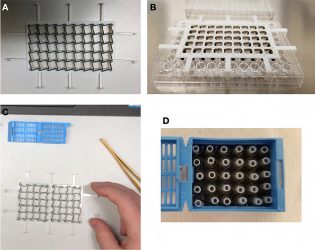
Purdue innovators have created a collapsible basket array for high throughput histology analysis of 3D organoids/spheroids (credit: Bumsoo Han/Purdue University).
“There is increasing scientific interest in 3D cell cultures derived either from one particular cell type, called spheroids, or from natural and intentional mixtures of multiple cell types, known as organoids,” said Bumsoo Han, a Purdue professor of mechanical and biomedical engineering and program leader of the Purdue University Center for Cancer Research.
“Our technology is designed to overcome the obstacles with the handling and analysis of 3D cultures,” added George Chiu, a Purdue professor of mechanical engineering. “Those processes are typically laborious, mostly manual and with a low throughput. Increasing throughput can benefit both drug discovery as well as personalised medicine.”
The researchers continued that the collapsible basket array is designed to be reconfigurable for high throughput culture and histological analysis.
Related topics
3D printing, Analysis, Analytical Techniques, Drug Discovery, High-Throughput Screening (HTS), Organoids, Personalised Medicine, Screening
Related organisations
Purdue University
Related people
Bumsoo Han, George Chiu, Thomas Siegmund