



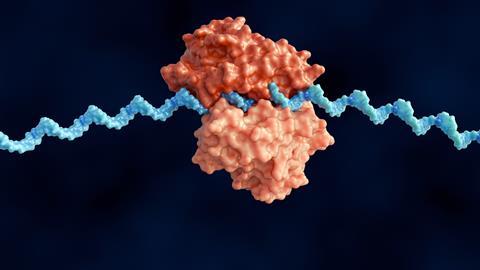
What happens when the cellular machinery making a therapeutic protein slows down? New research published in Nature shows how mRNA chemistry can create ribosome traffic jams, affecting both the amount and accuracy of protein production.
The success of a messenger RNA (mRNA) therapeutic depends on more than getting the molecule into the right cell. Once there, the cell must read the synthetic mRNA and produce the intended protein efficiently and accurately.
Chemical modifications to mRNA play an important role in this process. One widely used modification is N1-methylpseudouridine (m1Ψ), which is used in COVID-19 mRNA vaccines. It can improve translation while reducing unwanted immune recognition.
Researchers at the National Institutes of Health (NIH) and Johns Hopkins Medicine have now investigated another naturally occurring RNA modification, N4-acetylcytidine (ac4C) and compared how the two modifications affect mRNA translation.
Published in Nature, the study found that cells produced more protein from ac4C-modified mRNA than from m1Ψ-modified mRNA across several experimental systems. Importantly, ac4C still reduced the inflammatory response that synthetic mRNA can trigger to a similar extent as m1Ψ.
The researchers also investigated why protein production differed between the two modifications. They found that ribosomes moved considerably more slowly along mRNA containing m1Ψ. In other words, the type of chemical modification added to mRNA can affect how efficiently the cell reads its instructions and produces the intended protein.
This means the choice of mRNA modification could affect not only how much protein a cell produces, but how accurately that protein is made.
Why modify synthetic mRNA?
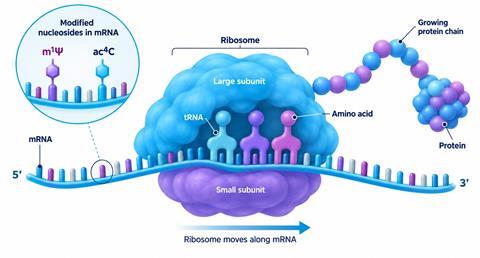
Messenger RNA carries genetic instructions that ribosomes, the cellular machinery responsible for making proteins, read and translate into proteins. For an mRNA therapeutic, researchers can design synthetic mRNA encoding a protein they want cells to produce and deliver it using a system such as a lipid nanoparticle (LNP).
Unmodified synthetic mRNA can activate innate immune pathways, which can promote RNA degradation and suppress protein production.
Nucleosides, the chemical building blocks used to make RNA, can themselves be modified. One example is m1Ψ, which is widely used in synthetic mRNA because it reduces recognition by the innate immune system while supporting protein production.
Approximately 170 RNA modifications are known, yet relatively few have been investigated for therapeutic mRNA.
One of these is ac4C, a naturally occurring modification of cytidine. Previous work suggested that ac4C could enhance translation, prompting the researchers to examine how it compares with m1Ψ and why the two modifications produce different outcomes.
From mRNA to protein
1. Delivery
Synthetic mRNA enters a cell, often carried inside a lipid nanoparticle.
2. Translation begins
A ribosome binds to the mRNA and starts reading its nucleotide sequence.
3. The ribosome moves along the transcript
Transfer RNAs deliver the amino acids specified by the mRNA sequence.
4. A protein is produced
The amino-acid chain is released and can fold into the protein encoded by the therapeutic mRNA.
How quickly and accurately the ribosome completes this journey can affect both the quantity and quality of protein produced.
More protein from ac4C-modified mRNA
The researchers compared ac4C with m1Ψ across cultured cell lines, primary human monocyte-derived dendritic cells and mouse liver.
They found that ac4C-modified mRNA produced higher protein yields than m1Ψ-modified mRNA across several experimental settings.
Importantly, this did not appear to come at the cost of greater innate immune activation. In primary human dendritic cells, both modifications suppressed inflammatory responses compared with unmodified mRNA, while ac4C generated higher protein yields.
The researchers also tested whether differences in delivery or mRNA stability could explain the result. Their experiments instead pointed towards the translation process itself.
To investigate what was happening, they needed to follow individual mRNA molecules as ribosomes translated them.
Watching translation one molecule at a time
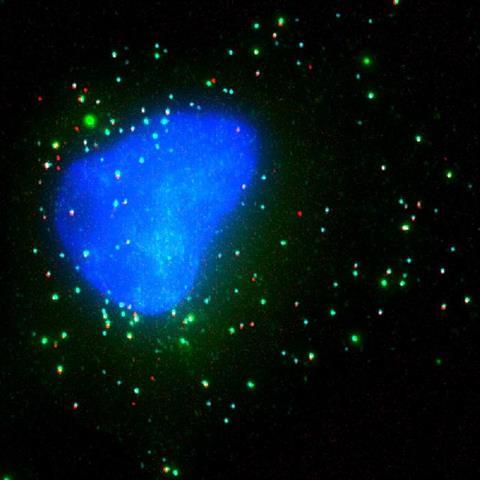
The team used single-molecule imaging of nascent peptides (SINAPs), an approach that allows active translation to be visualised on individual mRNA molecules inside cells.
Interestingly, m1Ψ-modified mRNA had more ribosomes associated with each mRNA molecule than ac4C-modified mRNA, despite producing less protein. This suggested that having more ribosomes on an mRNA did not necessarily mean that translation was more efficient.
The researchers investigated how quickly those ribosomes were moving. Ribosomes moved nearly twice as slowly along m1Ψ-modified mRNA as ac4C-modified mRNA. In ribosome runoff experiments, median runoff time was 13.7 minutes for m1Ψ-modified mRNA compared with 6.7 minutes for ac4C-modified mRNA.
In other words, more ribosomes were present, but they were moving more slowly and producing protein less efficiently.
The slower movement also increased the likelihood of ribosomes accumulating and colliding as they travelled along the mRNA.
What is a ribosome collision?
Several ribosomes can translate the same mRNA molecule at once.
If a leading ribosome slows or pauses, a ribosome travelling behind it can catch up. This can create a ribosome collision.
Cells have quality-control mechanisms that detect these events. Persistent collisions can trigger ribosome-associated quality control and affect how much complete protein is produced.
In this study, m1Ψ caused a greater slowdown in translation elongation than ac4C, increasing ribosome collisions and engagement of these quality-control pathways.
When translation loses its reading frame
Ribosome collisions can contribute to frameshifting, where the ribosome changes the way it reads the nucleotide sequence.
The genetic code is read in groups of three nucleotides called codons. Moving the reading frame by a single nucleotide changes every codon that follows, potentially producing an unintended protein sequence or causing translation to stop prematurely.
The researchers found that m1Ψ was associated with increased +1 frameshifting, particularly at U-rich sequences, while ac4C did not show the same increase at C-rich sequences. This provides another consideration for therapeutic mRNA design. Producing large amounts of protein is important, but the protein also needs to be translated accurately.

What is +1 frameshifting?
Imagine an mRNA sequence being read three letters at a time:
ABC | DEF | GHI | JKL
If the ribosome shifts the reading frame forward by one nucleotide, the groups change:
BCD | EFG | HIJ
The underlying mRNA has not changed, but the ribosome is now reading it in a different frame.
In a therapeutic mRNA, frameshifting can lead to truncated or unintended protein products. This makes translation fidelity, how accurately the intended protein is produced, an important consideration alongside total protein yield.
Why ac4C behaves differently
The researchers propose a model they call ‘braking upon modified position’, or BUMP. In this model, nucleotide modifications act as different degrees of brake as a ribosome travels along the transcript.
Unmodified mRNA can be translated rapidly but is more likely to activate immune pathways that suppress protein synthesis. ac4C produces a more moderate slowdown while allowing ribosomes to continue moving without extensive collision-prone stacking.
m1Ψ caused a greater reduction in elongation speed in the experiments, increasing the likelihood that ribosomes accumulated behind one another.
Counting how many ribosomes are associated with an mRNA does not necessarily reveal how productively those ribosomes are translating it. A transcript can have high ribosome occupancy because ribosomes are moving slowly and accumulating rather than rapidly producing protein.
What could this mean for mRNA therapeutics?
The findings do not mean that ac4C should simply replace m1Ψ.
m1Ψ has an established clinical track record and combines effective protein expression with reduced immune recognition. Different therapeutic applications may also benefit from different translation dynamics.
Instead, the study suggests that nucleotide modification could become another design variable when optimising synthetic mRNA.
For applications requiring high and accurate protein production, the combination of increased protein output, low inflammatory signalling and improved translation fidelity observed with ac4C could be valuable.
However, the current evidence remains preclinical. The researchers studied cultured cells, primary human cells and mouse liver, and further work will be needed to determine how the findings translate into therapeutic efficacy, dosing and safety.
Designing mRNA around the ribosome
The results show that ribosome occupancy alone does not indicate how efficiently an mRNA is being translated. Translation speed, ribosome collisions and the accuracy of protein production also need to be considered.
For mRNA therapeutics, this makes nucleotide chemistry an important part of optimisation. The modification used can affect not only immune recognition and protein output, but how the ribosome moves along the mRNA.
With approximately 170 RNA modifications known, relatively few have been investigated for therapeutic use. Determining how these modifications affect translation could help researchers identify which are best suited to different therapeutic applications.














No comments yet