


Application note: Development and utilisation of bromodomain and extra terminal domain (BET) assays using AlphaLISA technology
Posted: 3 January 2018 | Daniel Cardillo (PerkinElmer), Dawn Nida (PerkinElmer), Hong Cao (PerkinElmer), Jen Carlstrom (PerkinElmer) | No comments yet

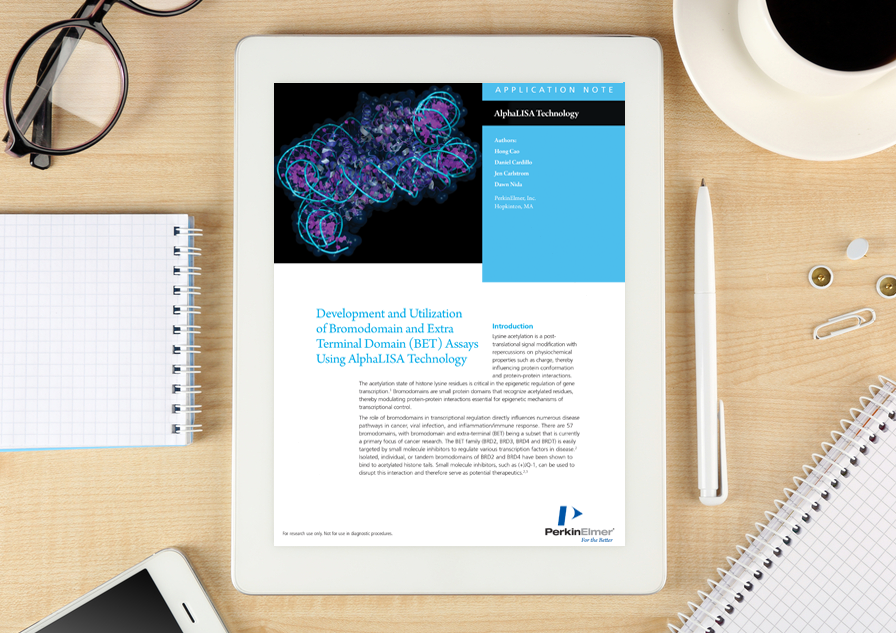
In this application note, PerkinElmer demonstrates the ease and utility of using AlphaLISA®, a homogeneous assay format, to screen for small molecular inhibitors of BET bromodomains.
Bromodomains are small protein domains that play a role in modulating protein-protein interactions essential for epigenetic mechanisms of transcriptional control. The role of bromodomains in transcriptional regulation directly influences numerous disease pathways in cancer, viral infection, and inflammation/immune response.
The BET family is a subset of bromodomains that is easily targeted by small molecule inhibitors, and isolated, individual or tandem BET bromodomains BRD2 and BRD4 has been shown to bind to acetylated histone tails. Small molecule inhibitors can be used to disrupt this interaction and therefore serve as potential therapeutics. Available assays for BET family bromodomain activity detect mainly tetra acetylated peptide surrogates, rather than the weaker binding mono- or di- acetylated peptide surrogates.
AlphaLISA assays can be used to detect low affinity binding interactions, allowing for screening of bromodomain inhibitors specifically targeted to mono- and di-acetylation states of the histone. AlphaLISA technology allows for the detection of molecules of interest in a homogeneous, no-wash format with a high sensitivity and is amiable to high throughput screening.
Here, we show that by using AlphaLISA technology assays specific for BRD4 bromodomain BD1 and various acetylated H4 histone-derived peptides, it is possible to screen and validate such targets and measure inhibitor potency.
This application note is restricted - login or subscribe free to access
 Thank you for visiting our website. To access this content in full you'll need to login. It's completely free to subscribe, and in less than a minute you can continue reading. If you've already subscribed, great - just login.
Why subscribe? Join our growing community of thousands of industry professionals and gain access to:
- quarterly issues in print and/or digital format
- case studies, whitepapers, webinars and industry-leading content
- breaking news and features
- our extensive online archive of thousands of articles and years of past issues
- ...And it's all free!
Click here to Subscribe today Login here
Related content from this organisation
- Global high-content screening market set to be worth $2.52bn by 2030
- Assays for protein degradation therapeutics to accelerate undruggable proteome discoveries
- Lab automation market set to increase at CAGR of seven percent
- Brochure: Biologics workflow solutions brochure
- Brochure: Viral research solutions
Related topics
Assays, Drug Discovery Processes, High-Throughput Screening (HTS), Immunology, Immunotherapy, Protein, Screening, Technology
Related organisations
PerkinElmer